China Flooring News: Housing Slowdown, Sustainability Pressure and LVT Design Are Changing July Orders
Published: June 24, 2026 | autoppfloor.com | Zhangjiagang, Jiangsu, China
Category: Flooring Industry News
Editor’s Note: AutoPP Floor Export Market Desk
Opening Note
This week’s flooring news is not a simple “market up” or “market down” story.
The U.S. housing channel is under pressure. Multifamily construction slowed sharply in May. Builder confidence is still weak. At the same time, commercial design and sustainability are not slowing down; LVT collections for workplace projects, healthcare material health and flooring sustainability events are still getting attention.
For Chinese SPC and LVT exporters, that gives a clear message: July orders will be more selective. Buyers will still purchase, but they will ask harder questions about price, project use, compliance, wear layer, installation risk and repeat-order stability.
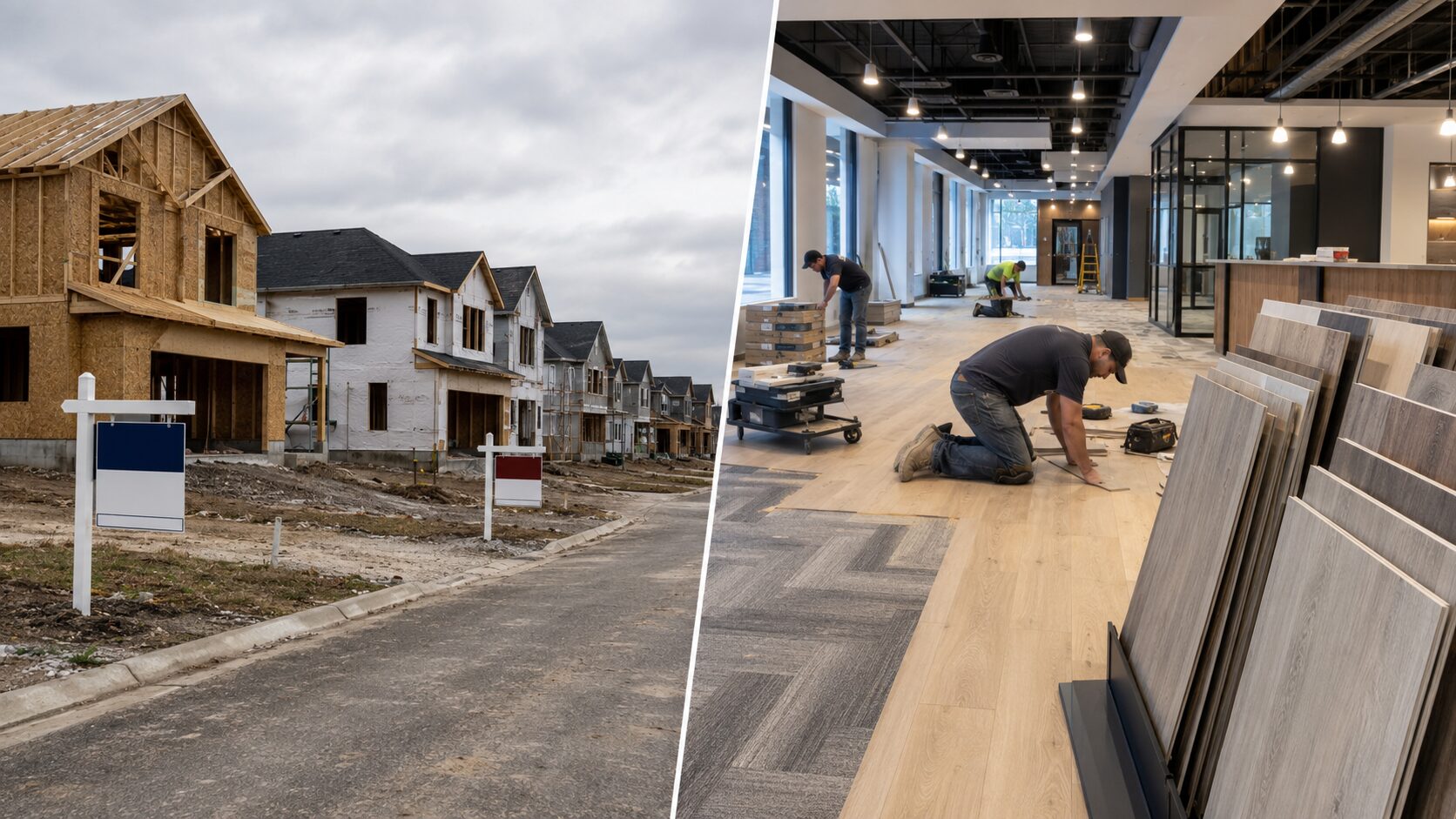
Image Caption: A market-facing news visual: U.S. housing slowdown on one side, commercial LVT and sustainability demand on the other.
1. Housing Starts Fell: Flooring Buyers Will Push Harder on Value
News Fact
According to Floor Covering News, citing NAHB, overall U.S. housing starts decreased 15.4% in May 2026 to a seasonally adjusted annual rate of 1.18 million units. Single-family starts fell 1.9% to 882,000 units, while multifamily starts dropped 40.2% to an annualized pace of 295,000 units.
That number matters for flooring.
When housing starts slow, flooring distributors become careful with inventory. They do not want warehouses full of slow-moving color lines. Builders do not want products that create claims. Retailers become more sensitive to landed cost, carton damage and replacement risk.
From the factory side, I would not read this as “demand disappears.” That is too simple.
A soft housing channel usually creates two types of orders.
The first type is price-sensitive: 4.0mm or 4.2mm SPC, basic oak colors, limited SKUs, tight carton cost, fast shipment.
The second type is risk-sensitive: better 5.5mm + 1.5mm IXPE, stronger click system, 20 mil wear layer, proper UV coating, better packaging, full documents.
The mistake is trying to serve both buyers with the same board.
For residential retail buyers, SPC flooring still has a strong position because it is waterproof, easy to install and simple to explain in stores. But buyers should not treat all SPC as equal. A 4.2mm/0.3mm board with stable core density is not the same product as a cheap low-density 3.5mm click plank.
Factory Reading
If the housing channel is weak, buyers will negotiate hard. That is normal. But once the quotation drops below a practical floor, the factory has only a few places to cut cost: core density, wear layer, UV coating, IXPE backing, carton strength or aging time after extrusion.
None of these cuts appear clearly on a quotation sheet.
They appear later in broken click edges, curled boards, shade variation and installation complaints.
For July orders, buyers should write the actual product structure into the purchase order, not just the product name.
2. Builder Confidence Stayed Weak: Dry Back LVT May Get More Attention
News Fact
Floor Covering News reported that the NAHB/Wells Fargo Housing Market Index fell two points to 35 in June 2026. The index has stayed below 40 for 14 consecutive months. The same report said 35% of builders cut prices in June, with an average reduction of 6%, and 62% used sales incentives.
This is important for flooring because builder pressure usually spreads to every material category.
When builders cut prices, they also pressure flooring suppliers. But in large apartment turns, rental housing and commercial corridors, the cheapest floating floor is not always the safest solution.
That is where LVT Dry Back Glue Down Flooring deserves a serious look.
Dry back LVT is not as easy to sell as click SPC in a retail showroom. It needs better subfloor preparation and proper adhesive. But in large project areas, it can be easier to repair by section, easier to manage in continuous spaces and more predictable when the installer knows the job.
The point is not “dry back is better than SPC.”
The point is: choose by jobsite.
A small DIY living room may fit SPC.
A multifamily corridor may fit dry back LVT.
A quick renovation store may fit LVT click.
A garage or workshop should not be forced into ordinary SPC.
That is why the full PVC flooring product range should be reviewed before a buyer locks one product for every project.
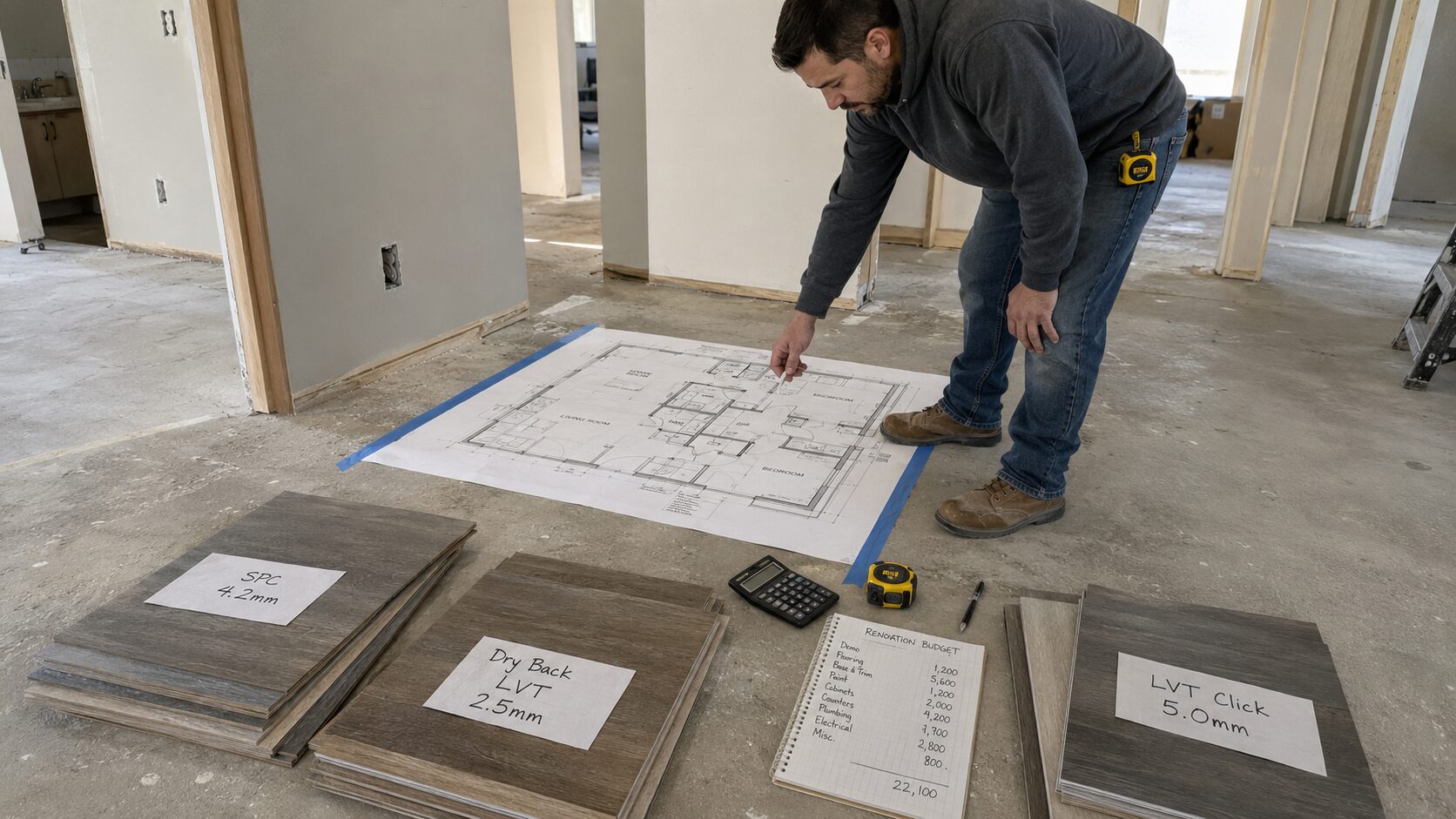
Image Caption: A project estimator comparing floating SPC and dry back LVT for multifamily renovation budgets.
Factory Reading
When a buyer says, “Give me the cheapest waterproof floor,” I usually ask: where will it be installed?
If it is a rental apartment with frequent tenant turnover, the answer may be different from a villa bedroom. If it is a commercial corridor with rolling loads, the answer may be different again.
This is the real WPC vs SPC comparison problem. Buyers often compare products by thickness only. That is not enough. You need to compare subfloor, traffic, repair method, temperature, cleaning routine and installer skill.
3. Sustainability Is No Longer Decoration; It Is Becoming a Purchasing Filter
News Fact
Floor Covering News reported that leading flooring companies will support the 2026 Flooring Sustainability Summit in Washington, D.C., July 15–16. The event will focus on responsible manufacturing, environmental stewardship and sustainable practices across the built environment. The report also noted programming around material health, circularity and supply-chain collaboration.
A few years ago, many buyers used “eco-friendly” as a brochure word.
Now it is becoming a checklist.
For export flooring, sustainability pressure usually shows up in five practical areas:
- VOC emission documents
- Phthalate testing
- REACH-related files
- Raw-material traceability
- Packaging and recycling discussion
For AutoPP Floor, this is not only about marketing. It affects how product specifications are discussed before production starts. If the buyer is selling to Europe, North America or a project channel, compliance documents must match the ordered product structure.
A FloorScore document is useful only when the buyer understands what it covers. A REACH file is useful only when it matches the product being supplied. A random old test report for “vinyl flooring” is not enough for serious procurement.
Eco-friendly vinyl flooring needs proof, not adjectives.
Factory Reading
Sustainability also affects recycled content discussions.
Controlled recycled material is not automatically bad. But uncontrolled recycled filler inside an SPC core is a different story. That can affect brittleness, odor, density stability and click strength.
Buyers should ask where recycled material is used, how it is controlled, and whether the finished board still meets physical performance requirements.
If the supplier cannot answer, do not rely on the word “green.”
4. Commercial LVT Design Keeps Moving Upmarket
News Fact
On June 8, 2026, FCNews reported that Tarkett launched Transcribe, a carpet tile and LVT collection for workplace settings. The article states that the collection includes six LVT styles, each in four colorways. The LVT is available in 3mm Contour LVT with a 32-mil wear layer and Techtonic polyurethane floor coating.
This is a useful signal for China flooring export 2026.
Commercial LVT is not just wood-look plank anymore. Workplace and hospitality projects are asking for identity, zoning, movement, muted design, stronger surface coating and higher wear resistance.
For Chinese factories, that means the easy catalog era is ending.
A buyer may ask for:
- Wider design range
- More stone and abstract visuals
- Matte finish
- Low-repeat digital print
- Better UV coating
- Higher wear layer
- Stable color batch control
Digital printing SPC flooring and advanced LVT visuals can help importers move away from pure price competition. But better design also demands better process control.
A beautiful surface with unstable gloss is a bad product.
A deep texture with weak wear resistance is a bad product.
A premium visual with poor carton-to-carton color control is a bad product.
For project buyers, Waterproof LVT Click Vinyl Flooring can serve retail and renovation spaces where fast installation matters. For large commercial spaces, dry back LVT may still be the more practical structure.
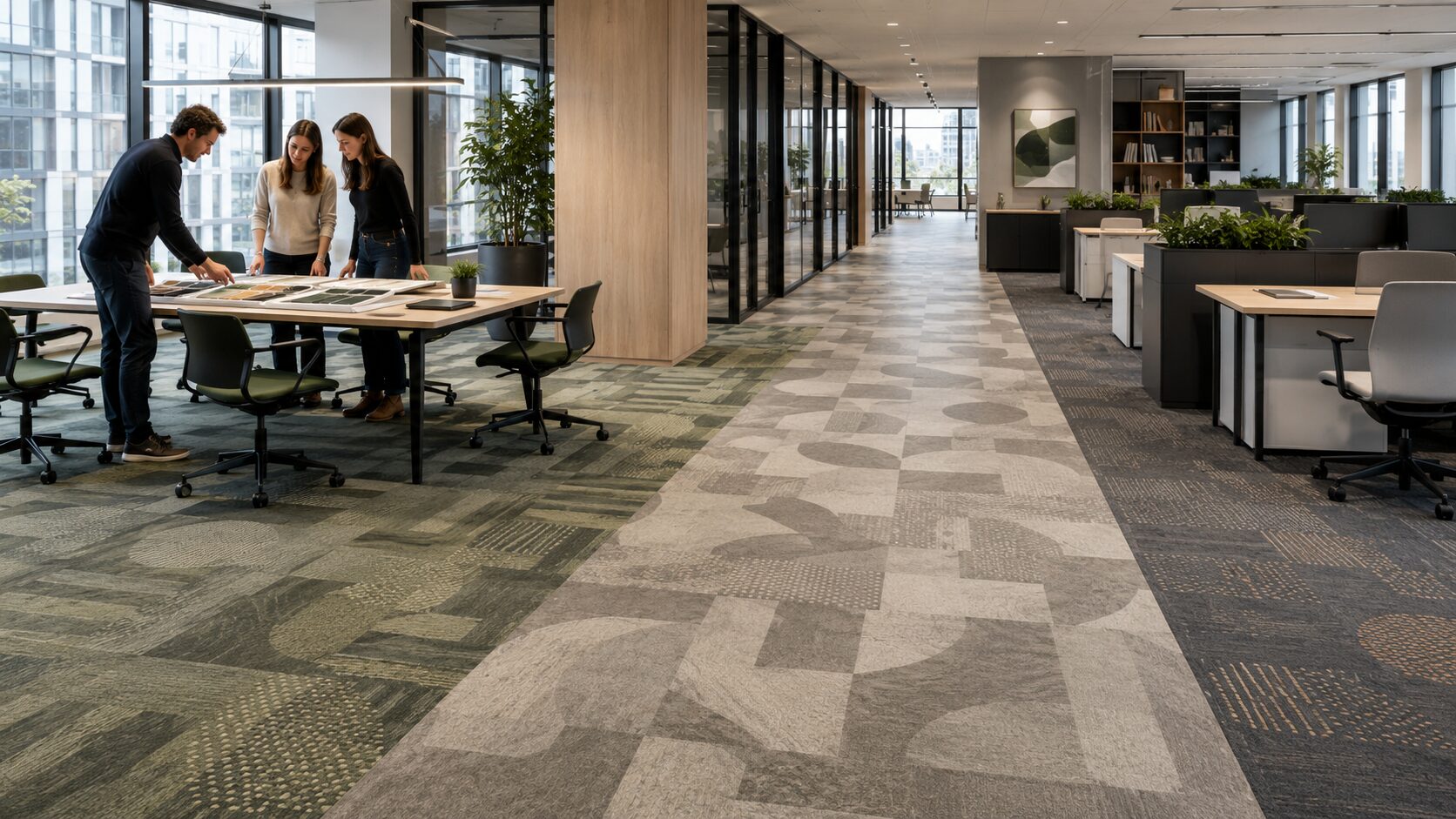
Image Caption: Workplace flooring zones showing how LVT is moving from basic plank to designed commercial surfaces.
Factory Reading
For commercial LVT, do not ask only for color.
Ask for wear layer, coating type, surface gloss tolerance, dimensional stability and repeat-order color control.
If the buyer wants a 32-mil commercial-grade lane, then price comparison with thin residential products is meaningless. They are not the same product.
5. PVC Price Is Softer, But Buyers Should Not Use It Wrong
News Fact
Trading Economics reported that Polyvinyl traded flat at 4,486 CNY/T on June 24, 2026. The same data page stated that Polyvinyl fell 8.36% over the past month and was down 6.87% compared with the same time last year.
This gives importers some negotiation room.
But it does not mean every low quotation is safe.
PVC resin is only one part of the flooring cost. SPC and LVT also include calcium carbonate, stabilizers, décor film, wear layer, UV coating, backing, carton, pallet, labor, electricity, machine wear and inland transport.
If PVC drops 8% but a supplier cuts the finished product price by 18%, ask where the other 10% came from.
The answer may be inside the board.
For garage, workshop and utility areas, buyers should also avoid forcing normal SPC into impact-heavy spaces. Interlocking Garage Floor Tiles may be a more honest solution where modular replacement and surface impact resistance matter more than living-room décor.
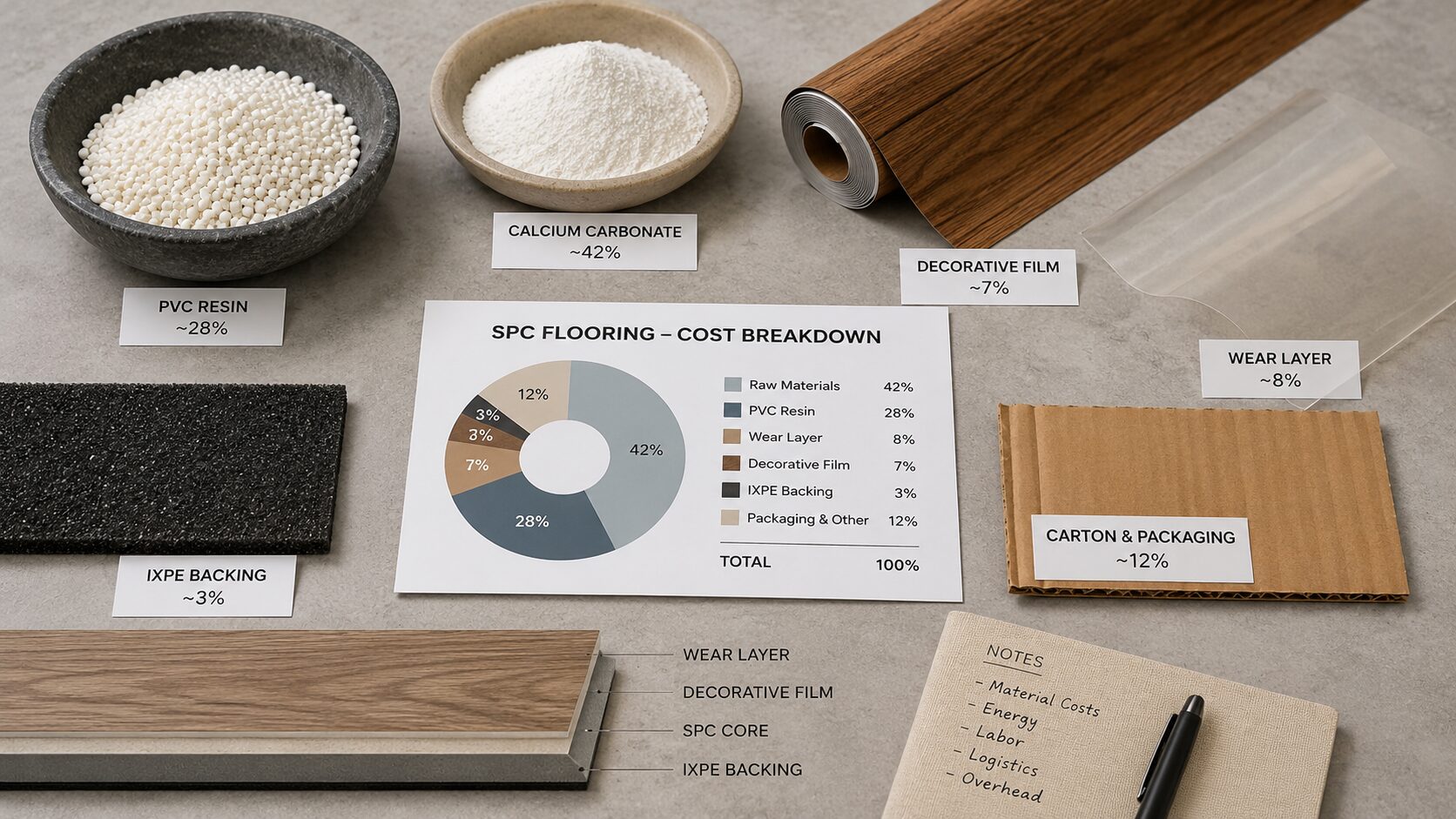
Image Caption: PVC cost movement should guide negotiation, but it should not replace product testing.
Buyer Control Table for July 2026 Orders
| Market Signal | Verified Data Point | Buyer Risk | Practical Action |
|---|---|---|---|
| U.S. housing starts slowed | May starts down 15.4% | Price pressure moves upstream | Avoid approving quotation without product structure |
| Multifamily dropped sharply | Multifamily starts down 40.2% | Project orders become more selective | Match SPC, dry back LVT or LVT click by jobsite |
| Builder sentiment weak | HMI at 35 | Builders push lower cost | Protect density, wear layer and packaging standards |
| Sustainability rising | Summit July 15–16 | Buyers ask for better documents | Match test reports to exact product |
| Commercial LVT moving up | 3mm LVT, 32-mil wear layer in new workplace line | Design specs become more demanding | Control gloss, coating and batch color |
| PVC softer | 4,486 CNY/T; down 8.36% in one month | Buyers may over-push price | Use cost window to upgrade specs, not downgrade |
Old Factory Advice
This week’s news is not telling us to panic.
It is telling us to be more careful.
Housing is soft, so price pressure will continue. Sustainability is rising, so documents matter more. Commercial LVT is becoming more design-driven, so factories must control surface quality. PVC prices are lower, so buyers have negotiation room — but that room should be used to secure better product structure, not to chase unsafe quotations.
For importers buying SPC flooring from China, the July purchase rule is simple:
Buy the right floor for the right site.
Do not use one 4.0mm click product everywhere. Do not buy dry back LVT if your installer cannot handle subfloor preparation. Do not push ordinary SPC into garages. Do not approve commercial visuals without checking coating and wear layer.
A good supplier should help you choose, not just quote.
Buyers who want to understand AutoPP Floor’s manufacturing background can review the factory introduction. For quotations, send target country, application area, thickness, wear layer, backing, certification requirements and annual volume through the AutoPP Floor contact page.
Published by AutoPP Floor | Zhangjiagang, Jiangsu, China