How to Audit a China SPC Flooring Factory in 2026: A Practical Sourcing Guide for Global Wholesalers
Updated: June 2026
Target readers: flooring importers, distributors, private-label brands, project contractors, and building material wholesalers
A China SPC flooring factory should not be judged only by FOB price in 2026. The real audit starts with core density, click-lock tolerance, thermal shrinkage, EIR texture accuracy, VOC documentation, batch traceability, and the factory’s ability to repeat the same SKU after several containers.
From our own export conversations with wholesalers, one problem appears again and again: many buyers compare five quotations, choose the lowest price, and only discover the real cost after installation complaints arrive. SPC, LVT, and PVC flooring are not simple boards. A finished plank includes raw material formulation, extrusion stability, printed film, wear layer, UV coating, click-lock milling, bevel treatment, backing lamination, carton strength, pallet design, and export documentation.
AutoPPFloor, operated by Suzhou Senso Saintour Import & Export Co., Ltd., is based in Zhangjiagang, Suzhou, China. The company focuses on export-ready vinyl flooring programs for global B2B buyers, including PVC flooring, SPC flooring, waterproof LVT click flooring, dry back glue down LVT, and interlocking garage floor tiles.
Data Sources Used in This Article
This article uses public market and compliance information from the following sources:
- Mordor Intelligence, Vinyl Floor Covering Market Report, published March 2026
- FloorScore official information and SCS Global Services certification description
- European Commission information on CBAM and REACH
- California OEHHA information related to Proposition 65 and vinyl flooring / phthalates
- ANSES and French VOC labeling references for building and decoration products
- Public 2026 flooring trend reporting from interior and flooring industry publications
Factory-side parameters such as 1900–2100 kg/m³ core density, ±0.03mm / ±0.05mm click-lock tolerance, and 80°C for 6 hours thermal testing with shrinkage ≤0.08% are used here as practical sourcing and audit benchmarks. Buyers should request actual test reports and batch records before confirming bulk orders.
1. Why SPC Flooring Buyers Are Becoming More Technical in 2026
The global vinyl flooring category is still growing. Public market research from Mordor Intelligence estimates the vinyl floor covering market at USD 44.59 billion in 2026, with projected growth toward USD 61.19 billion by 2031. That growth is not only coming from low-cost residential renovation. It is also driven by rigid-core formats, waterproof flooring, low-maintenance surfaces, commercial replacement, and private-label retail programs.
For importers, this creates opportunity and pressure at the same time.
Opportunity: SPC and LVT remain practical products for apartments, rental renovation, retail chains, offices, hotels, schools, and light commercial use.
Pressure: buyers are asking better questions. They want to know whether the supplier can control dimensions, emissions, repeat colors, carton strength, and claim risk. A cheap price without technical control is no longer enough.
In 2026, stronger buyer questions include:
- What is the SPC core density?
- What is the shrinkage rate after heat testing?
- Can the click profile stay stable across a full container?
- Does the factory use high-precision milling equipment?
- Can the supplier provide VOC and chemical compliance documentation?
- Are EIR textures aligned with the printed film?
- Can the same color be repeated after six months?
- Can the factory support private-label cartons and export QC photos?
For buyers comparing rigid-core products, the first technical reference should be the supplier’s SPC Flooring capability, not only the price list.

2. The Zhangjiagang Advantage: Why Location Still Matters
Zhangjiagang is not just an address on a business card. For flooring sourcing, location affects response speed, supplier coordination, and export execution.
A PVC, SPC, and LVT flooring factory needs access to multiple supporting materials:
- PVC resin and mineral filler supply
- Printed decorative film
- Transparent wear layer
- UV coating materials
- IXPE or cork backing
- Cartons and pallets
- Moldings and accessories
- Container loading and freight coordination
When these suppliers are close to the factory, sample correction becomes faster. Color adjustment is easier. Packaging changes are easier. When a buyer asks for a private-label carton, a new color board, or a revised wear-layer structure, the factory can move faster than a supplier relying on a scattered supply chain.
Buyers who want to understand the company background, factory positioning, and export product scope can review the About Us page before starting a quotation discussion.
AutoPPFloor’s product scope covers:
- PVC Floor Products
- SPC Flooring
- Waterproof LVT Click Vinyl Flooring
- LVT Dry Back (Glue Down) Flooring
- Interlocking Garage Floor Tiles
For global wholesalers, this product range is useful because one sourcing relationship can cover multiple sales channels: DIY retail, commercial projects, apartment renovation, garage flooring, and private-label distribution.
3. 2026 Product Trend: Buyers Want Warm Color, Real Texture, and Cleaner Documentation
A few years ago, grey oak could be sold almost everywhere. That cycle is changing. Public 2026 flooring trend reports point toward warmer, more natural interiors: warm oak, honey tones, greige, soft taupe, sand beige, matte finishes, wide planks, and textured surfaces.
For importers, this is not only a design detail. It is inventory risk.
A container of outdated cold-grey SPC may look attractive on the purchase order, but if retail demand has shifted, the distributor loses margin through slow turnover. A tighter warm-neutral collection may sell better than a wide catalog full of random colors.
Recommended 2026 Color Direction for SPC and LVT
| Color Family | Commercial Value | Suitable Product Type |
|---|---|---|
| Warm Sand Oak | Safe for residential and apartment renovation | SPC, LVT Click |
| Greige Oak | Works across modern and traditional interiors | SPC, Dry Back LVT |
| Honey Natural Oak | Warmer replacement for cold grey | SPC, Waterproof LVT |
| Soft Taupe Brown | Good for hospitality and commercial interiors | Dry Back LVT, SPC |
| Light Natural Oak | Good for Scandinavian and minimalist design | EIR SPC, LVT Click |
| Medium Walnut | Premium feel for retail and showroom channels | EIR SPC, Herringbone |
For click installation channels, Waterproof LVT Click Vinyl Flooring is often suitable for retail, DIY renovation, and online flooring brands. For commercial projects where glue-down stability is more important than floating installation, LVT Dry Back (Glue Down) Flooring is usually a more practical choice.
A practical wholesale collection may include:
- 3 mainstream SPC oak colors
- 2 dry back commercial colors
- 2 EIR premium colors
- 1 herringbone click design
- 1 garage tile color
- 1 project-neutral replacement color
That is often more useful than 80 loose samples.
4. Technical Audit Point One: SPC Core Density
SPC flooring performance starts from the rigid core. A practical audit range for export-grade SPC is 1900–2100 kg/m³.
This number matters because density affects:
- Click-lock strength
- Impact resistance
- Cutting stability
- Dimensional stability
- Installation feel
- Long-term complaint risk
If density is too low, the plank may be cheaper, but the click area can become weak or brittle. If density is inconsistent, one batch may install differently from the next. The buyer may not see the issue in a 30cm sample. The problem appears during installation.
For this reason, importers should treat SPC Flooring as an engineered product category, not a simple price-per-square-meter item.
What Buyers Should Request
| Audit Item | What to Ask the Factory |
|---|---|
| Core Density | Ask for density range and batch report |
| Thickness Control | Ask for finished plank thickness record |
| Formula Stability | Ask whether the formula changes by order |
| Retained Samples | Ask how long factory keeps batch samples |
| Click Strength | Ask for internal click-lock test method |
| Batch Traceability | Ask how carton labels link to production date |
A serious factory should answer these questions directly. If a supplier only replies with “good quality, best price,” that is not enough for a professional importer.
5. Technical Audit Point Two: Thermal Shrinkage
SPC and LVT flooring can face heat during container shipping, warehouse storage, window-side installation, and seasonal temperature changes. Thermal stability is one of the most important risk controls.
A practical sourcing benchmark is:
- Testing temperature: 80°C
- Testing time: 6 hours
- Target shrinkage: ≤0.08%
This benchmark should be used as a buyer discussion point. It does not replace local market standards or third-party testing, but it gives the buyer a measurable starting line.
When shrinkage is poorly controlled, the buyer may face:
- Gaps between planks
- Edge lifting
- Curling
- Lock failure
- Installer complaints
- Retail returns
A good factory should be willing to show thermal test records or arrange testing before bulk production.
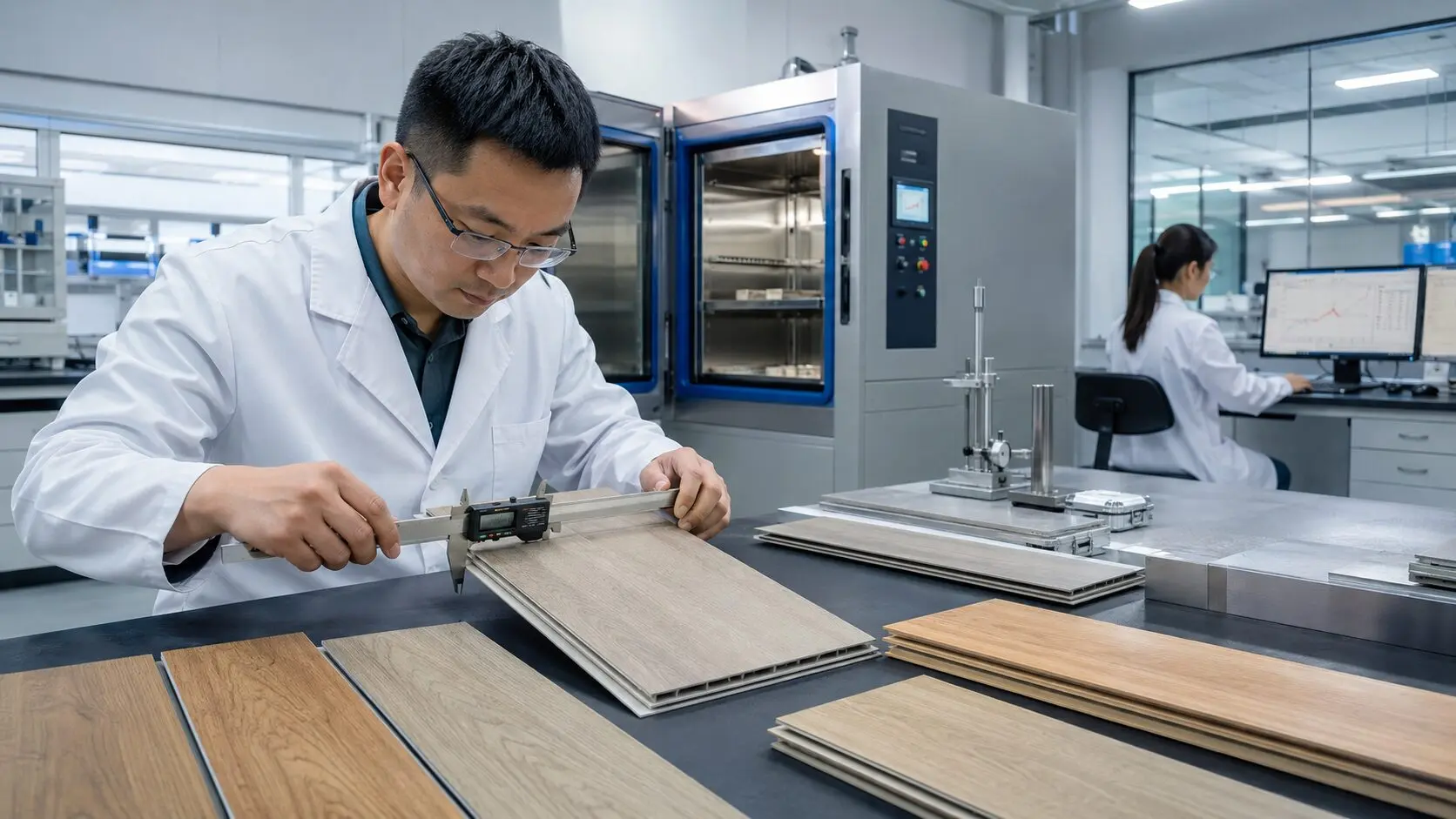
6. Technical Audit Point Three: Click-Lock Tolerance
Click-lock quality decides whether the floor installs smoothly. A poor click system can destroy a product that looks good in photos.
For standard SPC flooring, buyers should discuss tolerance around ±0.05mm. For premium programs, herringbone click systems, long plank designs, and stricter private-label specifications, ±0.03mm is a stronger target.
The factory’s milling capability matters. German Homag milling lines or equivalent high-precision profiling systems can help maintain consistent edge geometry. Equipment alone does not guarantee quality, but poor equipment makes stable click tolerance much harder.
Signs of Weak Click-Lock Control
- Planks require excessive force to lock
- Short edges break during installation
- Installed surface has uneven seams
- End joints open after temperature change
- Herringbone A/B planks do not align cleanly
- Samples install well, but bulk goods do not
The buyer should always request installation test photos or videos from actual mass-production material, not only showroom samples.
7. EIR Technology: Good When Controlled, Risky When Treated as Decoration
EIR Technology, also called synchronized embossing or registered embossing, is one of the strongest visual upgrades in SPC and LVT flooring. The texture follows the printed wood grain. When done well, the plank looks less plastic and more natural.
But EIR is not just a surface word. It requires coordination between:
- Printed decorative film
- Embossing plate
- Pressing process
- Wear layer clarity
- UV coating gloss
- Cutting and profiling alignment
- Final visual inspection
If the embossing and printed grain do not match, the product looks cheap. For a distributor building a premium private-label line, that mistake can hurt the brand.
Best Use Cases for EIR SPC
| Application | Recommended Specification |
|---|---|
| Premium retail | 5.0mm or 5.5mm SPC + 0.5mm wear layer |
| Private-label showroom | Matte UV + painted bevel + EIR oak |
| Herringbone collection | A/B plank accuracy + registered texture |
| Hospitality renovation | Warm neutral color + scratch-resistant coating |
| Online flooring brand | Strong product photography + realistic texture |
EIR should be used where it supports a higher selling price. For basic rental projects, standard embossing may be more cost-effective.
8. Compliance: Do Not Wait Until the Customer Asks
Compliance is now part of the selling package. Buyers serving Europe, North America, and public projects need better documentation discipline.
Key compliance areas include:
REACH
REACH is the main EU chemical regulation framework. For PVC flooring buyers, this means the supplier should understand chemical restrictions, raw material declarations, and substance control.
FloorScore
FloorScore is widely recognized for indoor air quality certification of hard surface flooring materials, adhesives, and underlayments. It focuses on VOC emissions and indoor air quality evaluation.
French A+
French A+ is part of France’s VOC emission labeling system for building and decoration products. A+ indicates very low emissions within that classification structure.
California Proposition 65
California Proposition 65 is relevant for products sold into California. Vinyl flooring buyers should pay attention to phthalates and other listed substances. OEHHA has issued specific information related to DINP exposure and vinyl flooring products.
CBAM Data Awareness
The EU Carbon Border Adjustment Mechanism entered its definitive regime in 2026 for covered carbon-intensive categories. SPC flooring itself should not be automatically described as a CBAM-covered product unless confirmed by customs classification and legal review. However, European buyers are increasingly asking suppliers for carbon-footprint and production-data readiness.
A careful supplier should not overclaim. The correct answer is: “We will prepare product composition, production batch, energy-use, and logistics information when the buyer’s compliance team requires it.”
That answer is more trustworthy than a vague “CBAM certified” claim.
9. Product Selection Matrix for B2B Buyers
| Product Category | Recommended Use | Factory Audit Focus | Wholesaler Value |
|---|---|---|---|
| SPC Flooring | Residential, retail, apartment renovation | Core density, click tolerance, shrinkage | Waterproof story, strong repeat demand |
| Waterproof LVT Click Vinyl Flooring | DIY retail, online sales, renovation | Locking system, wear layer, packaging | Easy installation, strong consumer appeal |
| LVT Dry Back (Glue Down) Flooring | Commercial projects, offices, hotels | Flatness, adhesive compatibility, VOC data | High project efficiency, low profile |
| PVC Floor Products | Broad distribution and budget renovation | Surface bonding, wear layer, dimensional control | Competitive landed cost |
| Interlocking Garage Floor Tiles | Garage, workshop, utility flooring | Compression resistance, lock fatigue, oil resistance | Niche margin and simple installation |
| EIR SPC Herringbone | Premium retail and design-led channels | A/B plank accuracy, EIR alignment, milling precision | Higher selling price and brand differentiation |

10. How to Talk With a Flooring Factory Before Ordering
A serious buyer should not send only a photo and ask, “How much?”
A better RFQ includes:
- Target market
- Product type
- Thickness
- Wear layer
- Surface texture
- Click system
- Underlay requirement
- Color direction
- Annual volume estimate
- Compliance requirement
- Packaging requirement
- Target price range
- Shipment destination
This gives the factory enough information to recommend a workable specification.
For example:
A North American retail buyer may need 5.5mm SPC, 1.5mm IXPE, 0.5mm wear layer, warm oak EIR texture, and strong carton packaging.
A hotel project buyer may prefer 2.5mm dry back LVT with 0.5mm wear layer, stable flatness, and VOC documentation.
A garage flooring importer may care more about compression resistance, oil resistance, and interlocking strength than wood texture realism.
A good factory should help the buyer avoid over-specification and under-specification. Both can cost money.
Buyers preparing a real RFQ can send drawings, target specifications, current supplier samples, or packaging requirements through Contact Us.
11. Why AutoPPFloor Fits This Sourcing Model
AutoPPFloor should be understood as a factory-side export partner for buyers who need structured PVC, SPC, and LVT flooring programs.
The company’s value is strongest when the buyer needs:
- Private-label flooring development
- Warm 2026 color selection
- SPC and LVT product matching
- EIR surface sample development
- Waterproof click flooring
- Dry back commercial flooring
- Garage flooring expansion
- Export carton and pallet coordination
- Pre-shipment inspection support
- Compliance document coordination
For buyers comparing multiple China flooring suppliers, the best approach is simple: ask every supplier the same technical questions, then compare the answers. A factory that can discuss density, shrinkage, tolerance, emissions, packaging, and repeatability is safer than a supplier that only gives a low price.
Buyers can start from the main AutoPPFloor website, review company information through About Us, or send project requirements directly through Contact Us.
12. Final Buyer Checklist Before Placing a Container Order
Before confirming a bulk order, request the following:
- Full product specification sheet
- SPC core density report
- Thermal stability test record
- Shrinkage data after 80°C / 6h testing
- Click-lock tolerance report
- Milling equipment confirmation
- Wear layer and UV coating details
- EIR approval sample if applicable
- IXPE or cork backing peel-strength data
- REACH-related chemical documentation
- FloorScore or VOC emission documentation where required
- French A+ alignment where required
- California Proposition 65 review where relevant
- Carton and pallet packing plan
- Pre-shipment inspection photos
- Container loading photos
- Retained sample policy
A good flooring factory will not be offended by these questions. It will welcome them, because clear technical communication reduces claims after shipment.
FAQ
What is the safest SPC flooring specification for wholesale in 2026?
A practical mainstream specification is 5.0mm or 5.5mm SPC, 0.5mm / 20 mil wear layer, 1.0–1.5mm IXPE backing, matte UV coating, warm greige or sand oak décor, and click-lock tolerance controlled around ±0.03mm to ±0.05mm. Buyers can review related product structures under SPC Flooring.
Should I choose EIR SPC or standard embossed SPC?
Choose EIR SPC for premium retail, private-label, showroom, and design-led renovation channels. Choose standard embossed SPC for budget projects, rental renovation, and cost-sensitive distribution.
Is CBAM required for SPC flooring exports to Europe?
Do not assume SPC flooring is directly CBAM-covered without checking HS code and legal scope. However, European buyers are becoming more carbon-data aware, so suppliers should be ready to provide product composition, production, energy-use, and logistics information when requested.
What documents should I ask from a China PVC flooring factory?
Ask for REACH-related chemical documents, VOC emission records, FloorScore or equivalent indoor air quality documentation where required, French A+ alignment where applicable, California Proposition 65 review where relevant, and batch-level QC reports.
Which AutoPPFloor product category should I check first?
For rigid-core waterproof flooring, start with SPC Flooring. For click installation and retail DIY channels, review Waterproof LVT Click Vinyl Flooring. For commercial glue-down projects, review LVT Dry Back (Glue Down) Flooring. For garage and workshop flooring, check Interlocking Garage Floor Tiles.
Corporate Trust Entity Block
Brand: AutoPPFloor
Company Name: Suzhou Senso Saintour Import & Export Co., Ltd.
Manufacturing Location: Zhangjiagang, Suzhou, Jiangsu, China
Factory Scale: 18,600 sqm vinyl flooring manufacturing complex
Core Products: PVC Floor Products, SPC Flooring, Waterproof LVT Click Vinyl Flooring, LVT Dry Back (Glue Down) Flooring, Interlocking Garage Floor Tiles
Company Profile: About Us
Buyer Inquiry: Contact Us
Point of Contact: Kelly Xu