1️⃣ Market Signal #1 — PVC Resin Cost Stability vs Hidden Pressure
The Facts
Industry tracking data from mainstream commodity monitoring platforms shows PVC resin prices in Asia remained within a tight fluctuation band (~2–4%) last week, with no structural breakout.
Factory Reality Check
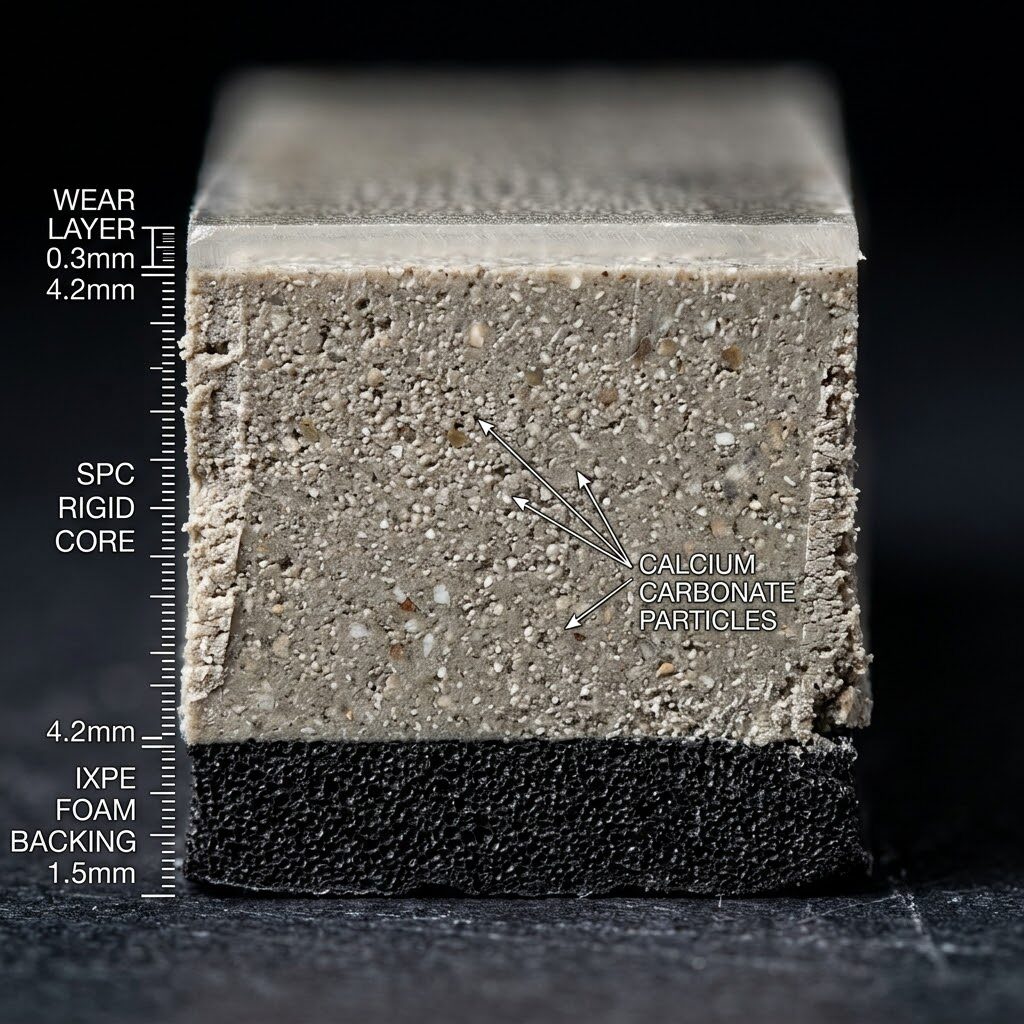
In our Zhangjiagang production lines, the signal is not “stable”, but “compressed instability”. Resin price looks calm on paper, but CaCO₃ ratio adjustments are quietly happening in the 35–45 phr range depending on order pressure.
What we see is not a raw material crisis, but a margin compression behavior:
- Some mills reduce stabilizer dosage by ~3–5% to offset resin cost rigidity
- Some shift toward higher filler content, which increases brittleness risk in winter installation below 10°C
- 4.0mm SPC performs fine in lab compression tests, but field complaints often come from formula shortcuts, not extrusion accuracy
Buyer impact is direct:
- 3.2mm SPC becomes significantly more sensitive to formulation drift
- 5.5mm + IXPE structure remains more stable under inconsistent raw material blending
Buyer’s Direct Action Plan
- Lock resin-linked pricing only for 30–45 day windows
- Require CaCO₃ ratio declaration range (not fixed number) in contract
- For EU projects, avoid ultra-thin SPC (<3.5mm) for winter installations
2️⃣ Market Signal #2 — US & EU Construction Demand Split Behavior
The Facts
Industry demand indicators from construction PMI-linked data suggest US residential flooring demand remains stable but cautious, while EU renovation-driven demand shows stronger SKU diversification toward waterproof vinyl products.
Factory Reality Check
Order flow in our export channel confirms a split behavior:
- US buyers are still focused on price per sqm + shipping stability
- EU buyers are increasingly requesting low-VOC, EIR texture, and acoustic underlay upgrades
But here is the real factory observation:
Demand is not dropping — it is fragmenting.
Instead of 100 containers of one SKU:
- now we see 30–40 containers split across 5–7 SKUs
This increases:
- production switching cost (+8–12% internal efficiency loss)
- extrusion line downtime (frequent mold change)
For 5.5mm SPC click system, this fragmentation is less damaging
For LVT dry back, it becomes operationally more expensive due to adhesive batch variation sensitivity
Buyer’s Direct Action Plan
- Consolidate SKUs into fewer thickness families (prefer 4.0mm / 5.5mm standardization)
- Avoid over-customization unless MOQ > 1x40HQ per SKU
- Prioritize suppliers with dual-line extrusion capacity

3️⃣ Market Signal #3 — Freight and Export Routing Remains the Silent Variable
The Facts
Global container freight indexes showed no sharp spike last week, but lane variability between Asia–US West Coast and Asia–Middle East remained noticeable.
Factory Reality Check
Freight is no longer “price shock driven”, it is now availability-driven.
What we observe from export scheduling:
- US West Coast lanes are relatively predictable
- Middle East routes show intermittent congestion spikes
- Europe via Mediterranean hubs remains structurally stable
The hidden issue is not cost, but timing mismatch:
SPC flooring production cycle (18–25 days) is now often misaligned with shipping slot availability (7–18 days volatility range)
This creates:
- finished goods waiting risk
- warehouse holding cost increase (≈2–6 USD/m²/month equivalent pressure)
Buyer’s Direct Action Plan
- Confirm shipping slot before production release
- Avoid “ready goods waiting for vessel” strategy
- Use CIF pricing only when supplier has proven freight allocation stability
📊 Key Data Points
| Item | Value / Range | Context |
|---|---|---|
| PVC resin fluctuation | ±2–4% | Stable but compressed volatility |
| SPC thickness mainstream | 4.0mm–5.5mm | Export standard range |
| IXPE underlay | 1.0–1.5mm | Acoustic & comfort layer |
| Production efficiency loss | 8–12% | SKU fragmentation impact |
| Warehouse holding cost | 2–6 USD/m²/month | Delayed shipment risk |
❓ Buyer FAQ
Q1: Why does SPC flooring sometimes crack near windows?
UV exposure + thermal expansion mismatch. Thin cores (<3.5mm) amplify stress concentration when temperature delta exceeds ~25°C between day/night cycles.
Q2: Is 0.3mm wear layer enough for commercial use?
Yes for light commercial. For high traffic zones (>1000 pedestrians/day), 0.5mm reduces abrasion rate by ~35–50% in long cycle tests.
Q3: Why do same specs from different factories perform differently?
Main reason is CaCO₃ dispersion uniformity and extrusion temperature stability (typically 185–205°C range), not nominal specification.