Quick Answer
Three developments are reshaping SPC flooring procurement this week.CFL Flooring marked 10 years since its SPC patent.It also launched m-SPC as a new premium material category.A flat 10% US Section 122 tariff still applies to Chinese goods.New Section 338 measures on Canada take effect on August 19.Container freight was $4,339 per 40-foot container on August 13.This is the Drewry WCI rate.It is up 8.93% over the past month.Buyers placing Q4 or early Q1 orders need to recalibrate landed-cost assumptions now—and understand what m-SPC means for future product specifications.
Ten Years of SPC—and the Material Just Evolved
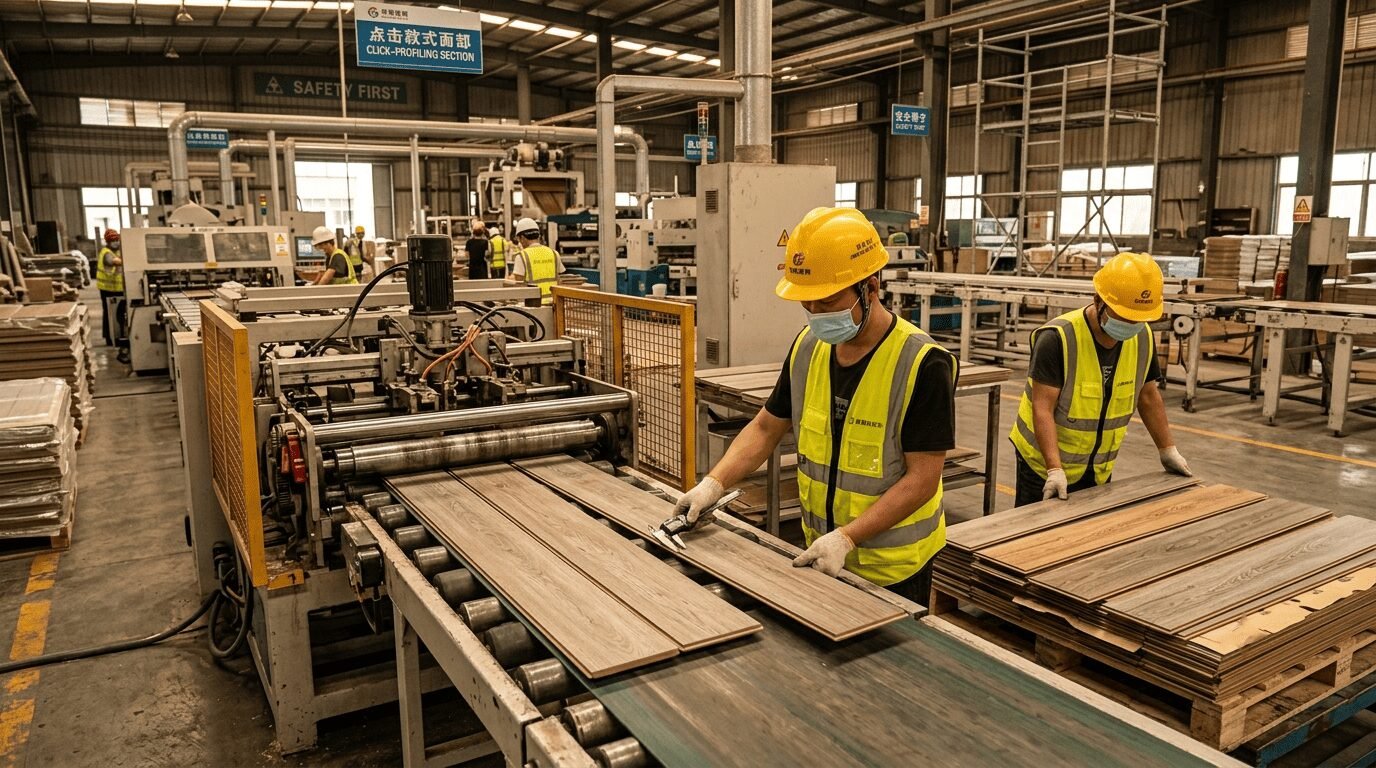
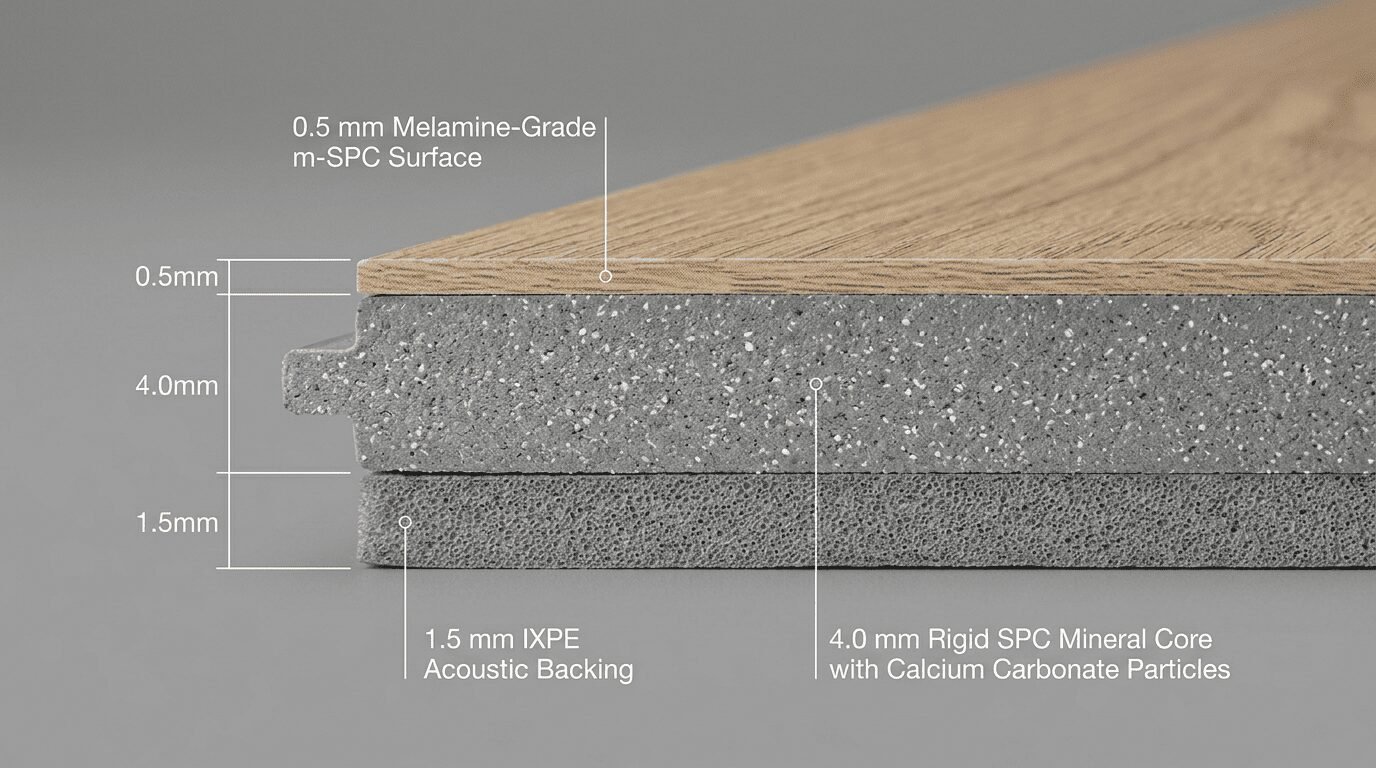
In August 2026, CFL Flooring received European patent EP 3907349, marking ten years since its first European SPC filing in 2016 (CFL Flooring, August 13, 2026). SPC—Stone Plastic Composite, the rigid-core format that replaced much of the LVT glue-down market over the past decade—did not emerge from a conference slide deck. It came from extrusion engineering: a heavily filled PVC compound with calcium carbonate loading high enough to create a dimensionally stable core without the wood-fiber moisture risk of WPC.
A decade in, the base material has been pushed about as far as it can go on its own. Wear-layer technology improved. Click profiles refined. IXPE backing became standard. Digital printing and EIR (Embossed-in-Register) surfaces closed the visual gap with natural materials. But the surface itself—UV-cured coating over a PVC decorative film—remained PVC’s weak point against some commercial-specification demands for scratch and stain resistance.
That’s the gap m-SPC is designed to close.
What m-SPC Actually Is—and Why It Matters to Buyers
In June 2026, CFL Flooring and i4F announced the commercial licensing of two technologies: Optibevel and m-SPC (i4F, May 26 / CFL, June 10, 2026).
Optibevel uses an in-line high-precision laser to cut decorative bevels directly in the profiling line—removing the mold-change complexity and gloss-inconsistency problems associated with pressed bevels. For factories running multiple plank formats, this has direct production-efficiency implications. The technology is compatible with SPC, WPC, LVT, and other thermoplastic substrates.
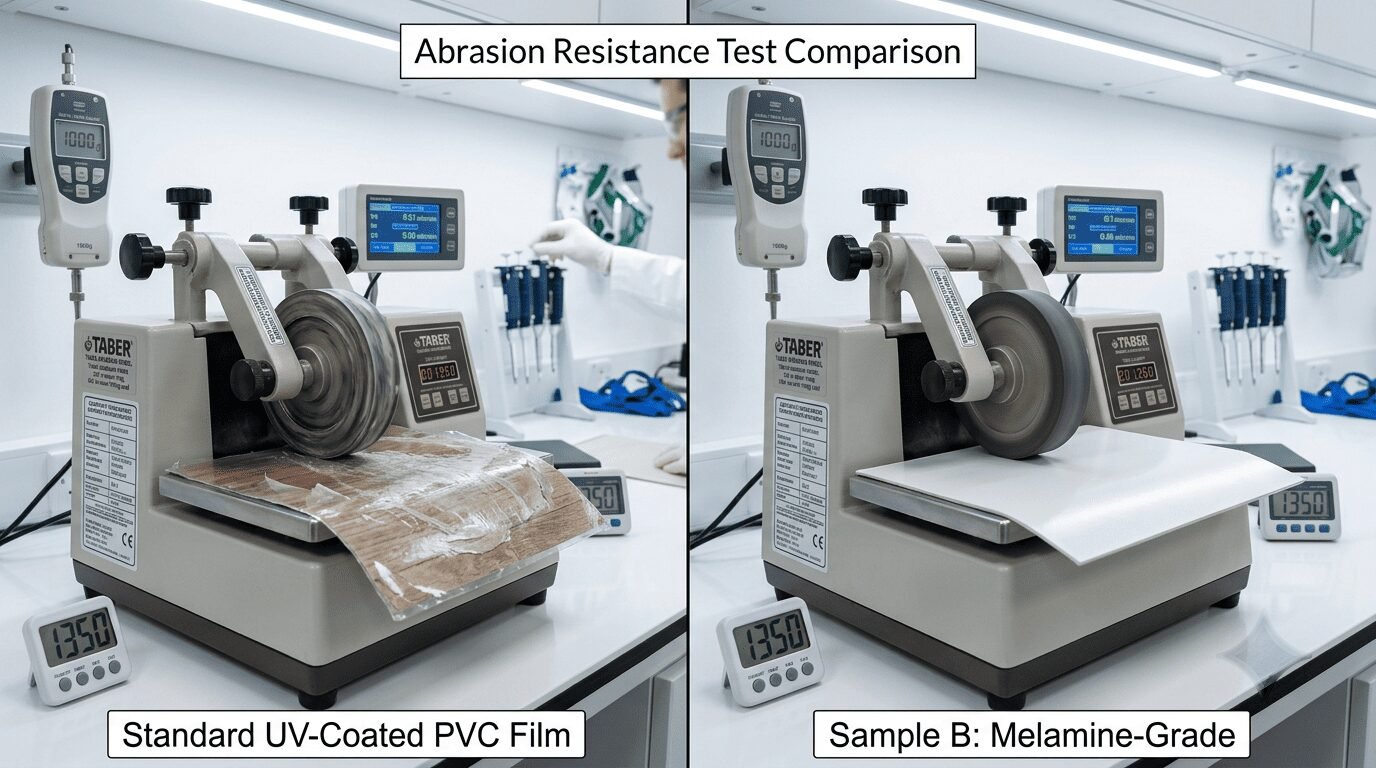
m-SPC is more structurally significant. It combines a waterproof SPC core with a melamine-grade surface layer, targeting scratch resistance, stain resistance, and wear performance beyond what a standard UV-coated PVC film can deliver. The positioning is explicitly premium: commercial interiors, heavy traffic zones, environments where conventional SPC wear-layer claims strain credibility.
For importers and distributors, the practical question is not whether m-SPC will displace standard SPC—it won’t, at least not at volume in the near term. The question is whether your product mix includes a tier that can credibly compete at the specification level where laminate currently holds market share in commercial projects. m-SPC is the first rigid-core format that can make that argument with a technical basis.
From a procurement standpoint: expect m-SPC to command a premium of 15–30% over equivalent-dimension standard SPC once it reaches broader production scale. Tooling, licensing, and compound costs are all higher. Buyers evaluating it should ask for third-party scratch-resistance and stain-resistance test data—not just comparative marketing language.
The Tariff Landscape Entering Late August
The US tariff situation heading into late August is complicated but manageable if you know where the current lines are.
The flat 10% Section 122 tariff, which had replaced earlier IEEPA-based measures, remains in force on Chinese goods as of this writing. The Section 122 measure was confirmed active as of the tariff tracker update from Baker Botts (July 21, 2026), with the broader landscape showing no material change to the rate applicable to Chinese SPC flooring imports since the earlier trade framework.
This week’s bigger move targets Canada, not China. On July 20, President Trump signed a Section 338 proclamation. It sets 50% duties on many Canadian goods. The duties take effect on August 19, 2026 (Baker Botts, July 21, 2026). While Canadian flooring production volume is not a primary driver of US import competition for Chinese SPC, the measure signals that tariff intervention continues to be used actively—and that buyers with multi-country sourcing strategies should track rate movements across all origin markets.
For Chinese SPC exporters, the practical checklist hasn’t changed substantially, but the enforcement environment remains active:
The EU market currently faces fewer tariff disruptions for Chinese SPC. The main compliance burden remains REACH/SVHC. It also includes FloorScore, or similar indoor air-quality certification. It also requires EN ISO dimensional and mechanical standards.

Freight: Still Elevated, Still Worth Managing Actively
Drewry’s World Container Index for the week of August 13, 2026 stood at $4,339 per 40ft container, up 1% week-on-week and up 8.93% over the past month (Trading Economics / Drewry WCI, August 13, 2026).
To put this in context for SPC flooring buyers: a standard 40ft container typically loads 1,800–2,000 m² of 5.5mm SPC (depending on packaging and pallet configuration). At current WCI levels, freight alone contributes approximately USD 2.17–2.41 per m² before port handling, destination fees, or insurance. Compare this to early 2025 levels—when China-US transpacific rates were tracking below $2,000/FEU—and the freight cost increment per square meter has roughly doubled.
The containerized freight index on Trading Economics was tracking at 3,355 points on August 18 (which covers a broader composite of routes). The directional signal is consistent: freight costs are elevated and have risen month-on-month.
What SPC buyers can do:
- Consolidate shipments. Moving from partial-container (LCL) loads to full 40ft containers meaningfully reduces per-m² freight cost.
- Extend production lead times deliberately. If a factory can produce to a longer booking window (12–14 weeks versus 8), there is more flexibility to select freight options.
- Review packaging density. Some manufacturers can adjust box configuration or plank count per pallet within standard container height/weight limits. Even a 5–8% improvement in packing density makes a measurable difference at current rate levels.
- Evaluate duty-deferral structures. Bonded warehouse or first-port-of-entry storage can create flexibility in duty payment timing if cash flow is a constraint.

Procurement Checklist for Mid-August 2026 Orders
Given the current market environment, the following specification and documentation requirements are worth including in any Q4 SPC purchasing cycle:
Product specification:
- Core thickness: specify ± tolerance (typical: ±0.1mm)
- Wear-layer thickness: specify method (EN ISO 24340 cross-section measurement) and tolerance (±0.05mm)
- Dimensional stability: request EN ISO 23999 test report from production batch—not pre-production sample
- CaCO₃ filler loading: request compound spec sheet; values above 60 phr warrant additional testing for thermal expansion
- IXPE backing thickness and density: specify g/m² or kg/m³ where acoustic performance matters
Documentation:
- Production test report per batch (not just per product development)
- Third-party SGS or Intertek inspection report if order volume warrants it
- Full REACH/SVHC declaration for EU-destined goods
- FloorScore or equivalent IAQ certification for US commercial specification
- Country of origin declaration with traceability to raw material level
Commercial terms:
- Confirm freight responsibility in writing (FOB vs CIF vs DDP)—current freight volatility makes ambiguity expensive
- Include a claim and replacement clause with defined acceptable defect rates and measurement methods
- Confirm production lead time in weeks from deposit receipt, not from PO date
FAQ
Q1: Should we consider m-SPC for our commercial project specifications now, or wait?
m-SPC is commercially available via licensed manufacturers now, but it is early-stage in terms of production scale and supply chain breadth. If you have a specific project requiring scratch and stain resistance beyond what a 0.5mm UV-coated wear layer delivers—particularly in hospitality, healthcare, or retail—it’s worth requesting a sample set and third-party test data from an i4F-licensed producer. For standard residential or light commercial supply, conventional SPC with a 0.3–0.5mm wear layer and a well-controlled compound spec remains more cost-effective and supply-chain predictable.
Q2: With the 10% US tariff still in place on Chinese goods, is there any benefit to sourcing from Vietnam or other Southeast Asian origins?
Third-country production can reduce tariff exposure, but the landed-cost arithmetic depends on: (a) what additional costs apply in the third country (raw material sourcing, production cost, freight from factory to port); (b) whether CBP considers the manufacturing process sufficient to confer origin (substantial transformation test); and (c) whether antidumping or circumvention orders apply to that origin-product combination. Do not assume a third-country origin eliminates risk without reviewing the specific HTS code and origin rules with a qualified trade attorney.
Q3: What is the minimum wear-layer thickness I should specify for a commercial SPC project?
For light commercial use (offices, showrooms with moderate foot traffic): 0.3mm minimum. For medium commercial (retail, hospitality, schools): 0.5mm. For heavy commercial or industrial environments: 0.7mm or above—at that specification, you are likely looking at heterogeneous PVC or specialty LVT rather than standard SPC. In all cases, specify the test method in the purchase order; wear-layer thickness claims from factories vary in how they are measured.
Closing Note
August 2026 is a useful moment to reassess what you’re buying, what it costs to move it, and what it’s worth at the destination. PVC resin on China’s DCE has stabilized at 4,588 CNY/T today (Trading Economics, August 18, 2026)—still roughly 6% below year-ago levels—which means factory-side compound costs remain moderate. The pressure is coming from logistics and tariff policy, not raw materials.
The emergence of m-SPC as a licensed material category also signals that the SPC value chain is not standing still. For buyers who compete in commercial or premium residential segments, understanding the technology trajectory matters for product development decisions made today.
Buyers reviewing AutoPP Floor’s SPC flooring range can compare current residential and commercial specifications directly. Projects requiring glued-installation formats can review the LVT dry-back range or waterproof LVT click vinyl options. For sourcing discussions or sample requests, the AutoPP Floor contact page is the direct route.
References
- CFL Flooring — “CFL Flooring Marks a Decade as the Inventor of SPC with New Patent Grant.” August 13, 2026. https://www.cflflooring.com/cfl-flooring-marks-a-decade-as-the-inventor-of-spc-with-new-patent-grant/
- i4F — “i4F Extends Partnership with CFL to Deliver Global Benchmark for Premium Enhanced Bevel Technology and New m-SPC Material Category.” May 26, 2026. https://i4f.com/article/i4f-extends-partnership-with-cfl-to-deliver-global-benchmark-for-premium-enhanced-bevel-technology-and-new-m-spc-material-category/
- Baker Botts — “Trump Tariff Tracker – July 21, 2026.” July 21, 2026. https://ourtake.bakerbotts.com/post/102ndeb/trump-tariff-tracker-july-21-2026
- Drewry / Trading Economics — World Container Index, week of August 13, 2026: $4,339/40ft. https://tradingeconomics.com/commodity/containerized-freight-index
- Trading Economics — DCE Polyvinyl (PVC) futures, August 18, 2026: 4,588 CNY/T. https://tradingeconomics.com/commodity/polyvinyl
- ECHEMI — Poly(vinyl chloride) price, China Domestic, August 14, 2026: 4,385 CNY/MT. https://www.echemi.com/productsInformation/temppid160705011656-polyvinyl-chloride.html
Published by AutoPP Floor Industry Team — Zhangjiagang, Jiangsu, China View the full AutoPP Floor PVC flooring product range →