For importers, wholesalers, and private-label flooring brands sourcing PVC flooring from China — a procurement-ready technical briefing grounded in current market data.
The PVC flooring category is larger and more technically demanding than it was three years ago. The US vinyl floor covering market is valued at USD 13.57 billion in 2026 and projected to reach USD 19.01 billion by 2031 at a 6.97% CAGR (Mordor Intelligence, 2026). Global vinyl floor covering is projected at USD 44.59 billion in 2026, growing toward USD 61.19 billion by 2031 (Mordor Intelligence Global Vinyl Floor Covering Report, 2026). Behind those numbers is a structural shift: buyers are not just purchasing cheaper square meters. They are specifying products that can pass retail listing reviews, withstand commercial installation audits, and carry the compliance documentation now required by European and North American procurement.
This guide covers the three commercial trends driving PVC flooring demand in 2026, the technical parameters that separate strong suppliers from unreliable ones, and the compliance documentation checklist a professional buyer should request before signing a volume order.
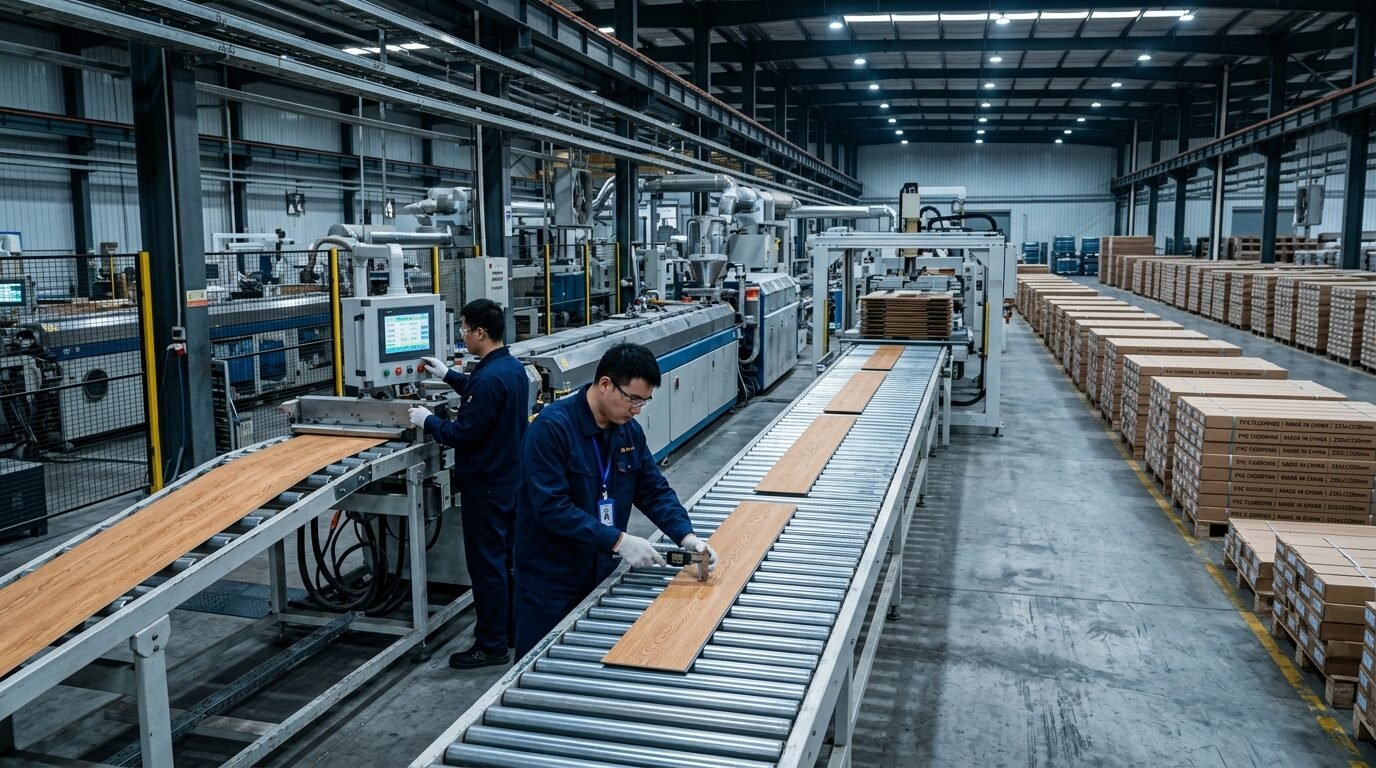
Data Sources & Methodology Note
Market size figures reference Mordor Intelligence’s United States Vinyl Floor Covering Market (2026 estimate: USD 13.57B) and Global Vinyl Floor Covering Market (2026 estimate: USD 44.59B). Technical benchmarks labeled as “factory-side sourcing specifications” reflect AutoPPFloor’s own manufacturing parameters and audit targets — they are not universal industry standards unless independently verified. Compliance descriptions reference official sources: ECHA (REACH), SCS Global Services (FloorScore), ANSES / French government sources (French A+), California OEHHA (Proposition 65), and the EU Commission.
1. Market Context: The PVC Flooring Buyer Has Changed
Ten years ago, most B2B PVC flooring buyers from China led with one question: “What is your FOB price per sqm?” The conversation started and ended with price, thickness, and delivery lead time.
In 2026, serious buyers arrive with multi-page technical specification sheets. They audit core density, click-lock machining tolerance, UV coating performance, surface texture fidelity, plasticizer type, and compliance document stacks — before negotiating price.
This shift is driven by three forces:
1. Retail and distribution tightening. Major home centers in the US and Europe now enforce chemical policies for flooring. Home Depot has committed to eliminating ortho-phthalates in vinyl flooring. Washington State regulations cap ortho-phthalates at 1,000 ppm effective January 1, 2025. A factory without phthalate-free documentation is simply not eligible for those retail programs.
2. End-consumer design expectations. EIR-synchronized surfaces, warm neutral palettes, and long-plank herringbone formats have moved from premium differentiators to standard expectations across mid-market distribution. A cold grey flat-embossed plank that cleared customs without issue in 2022 may sit in a distributor’s warehouse in 2026.
3. Commercial project compliance gates. For hotels, offices, healthcare, and public procurement in Europe, EPD documentation, FloorScore VOC certification, and REACH declarations are procurement qualifiers — not optional additions.
The factories that understand this shift are the ones worth sourcing from. The ones that do not have already started losing their stronger accounts.
2. Three Commercially Active Trends in 2026
Trend 1: EIR Surface Specification Is Now Mid-Market Baseline
Embossed In Register (EIR) technology synchronizes the mechanical embossing pattern with the decorative film print at the register level. When the grain line, knot pattern, and wood-tone variation all align with the surface texture, the result looks convincingly like real wood under showroom lighting and when touched.
When they do not align — as in standard mechanical emboss — the mismatch is obvious to any retail buyer who has seen EIR product side by side. That visual difference is a sell-through problem, not just a design preference.
In 2026, the commercially active design directions for EIR PVC and SPC flooring include:
- Warm oak, greige, honey oak, and raw wheat tones (replacing cold grey programs)
- Wide-plank long formats (1800mm+ lengths in premium residential)
- Herringbone A/B click systems for design-led distribution channels
- Matte and ultra-matte finishes at 0–5° gloss level for commercial and hospitality
For importers building private-label programs: The EIR specification raises perceived retail value without changing logistics or cost structure. A 5.0mm SPC plank with EIR warm-oak decor can position meaningfully higher in shelf placement than an equivalent flat-emboss product with the same core construction.
When reviewing EIR samples, always request two production-date-separated samples and compare them under side lighting. EIR registration can drift between press runs if the factory does not control film-to-plate alignment. Consistent alignment across batches is the real test.
Trend 2: Phthalate-Free Formulations Are a Commercial Gate, Not a Marketing Claim
The move away from ortho-phthalate plasticizers in PVC flooring is no longer optional.It is now a business requirement for sales in major retail and institutional channels.This applies across North America and Europe.
The practical procurement implication: if your supplier cannot provide a plasticizer declaration that names the plasticizer used. Examples include DINP, DOTP, bio-based alternatives, or other non-phthalate types. The supplier should also provide test results that confirm compliance with applicable standards. Without this, your shipment faces retail listing risk and customs documentation risk. It may also create potential liability exposure for downstream distributors.
What to request from a supplier:
- Plasticizer type declaration (specific compound name, not “eco-friendly plasticizer”)
- Test results for restricted phthalates under EU REACH SVHC Candidate List
- California Proposition 65 documentation for US-bound programs
- Stabilizer system disclosure (calcium-zinc is the current standard for heavy-metal-sensitive markets)
Do not accept a vague “REACH compliant” claim. Request the actual SVHC declaration with the current ECHA Candidate List version referenced.
Trend 3: Acoustic IXPE Integration Is Standard Specification for Commercial Programs
Pre-attached IXPE (Irradiated Cross-Linked Polyethylene) underlayment is now the most common hotel backing choice.It is widely used in multi-family homes, corporate offices, and healthcare renovation projects.Its acoustic benefit over EVA is clear and often listed in project specifications.
SPC systems with built-in IXPE reduce impact sound. They lower it by about 18–22 dB ΔLw. (Yosemite Flooring, 2026 Commercial Flooring Trends Guide). That performance is relevant for any multi-story installation where footfall and rolling chair noise affect occupant comfort.
Current market standard for backing specification:
- 1.0mm IXPE: entry-level commercial, light residential
- 1.5mm IXPE: mainstream residential and mid-market commercial (most active segment)
- 2.0mm IXPE: hospitality, premium multi-family, acoustic-sensitive office
IXPE’s cross-linked polyethylene structure resists compression set better than EVA under sustained loads. This helps acoustic performance last longer in busy commercial spaces. It also reduces sound loss as the backing compresses.
3. Technical Audit Parameters: What to Verify Before Placing Volume Orders
SPC Core Density
For SPC flooring, core density directly affects dimensional stability, click-lock strength, and long-term flatness under thermal cycling. As a factory-side sourcing audit benchmark from AutoPPFloor, mid-to-premium programs target core density in the range of 1,900–2,100 kg/m³.
Request batch QC records, not just a specification sheet. A factory that controls this parameter will have production data. One that does not will have a specification sheet only.
Click-Lock Machining Tolerance
Click systems depend entirely on milling precision. Loose tolerances produce installation gapping, joint peaking, locking failures, and warranty photo claims from contractors. High-precision milling lines hold click-lock tolerances within ±0.03–0.05mm. Factory-side audit benchmark from AutoPPFloor specifies German Homag milling lines or equivalent-grade equipment as the reference for tolerance control at this level.
Herringbone formats are especially sensitive to this. A regular straight-lay plank installation hides minor milling inconsistency. A herringbone A/B plank system exposes every deviation in click fit and dimensional accuracy.
Thermal Stability
For underfloor heating applications or climates with large temperature swings, thermal stability testing is a relevant procurement parameter. Factory-side audit benchmark: heat exposure at 80°C for 6 hours, with thermal shrinkage at or below 0.08%. Request documented test results — not a verbal assurance.
Wear Layer and Surface Coating
For commercial projects in the EU and US, a 0.55 mm wear layer is now a common standard.It is often specified for heavy-traffic zones (Yosemite Flooring, 2026 Commercial Flooring Trends Guide).

4. Product Category Comparison: Matching Format to Buyer Type
5. Compliance Documentation: What to Request and What Each Item Actually Means
EU REACH (SVHC Candidate List)
REACH is the primary EU chemical regulatory framework. For PVC flooring buyers, the practical concern is restricted phthalates and other Substances of Very High Concern on the ECHA Candidate List. Do not accept a generic “REACH compliant” claim. Request:
- A current SVHC declaration referencing the specific ECHA Candidate List version
- Test reports for restricted substances
- Plasticizer type identified by compound name
FloorScore
FloorScore is an indoor air quality (IAQ) certification program administered by SCS Global Services, covering hard-surface flooring materials, adhesives, and underlayments. Products must be independently tested and certified against specific VOC emission limits — it is not a self-declaration. If a supplier claims FloorScore certification for a product, request the certificate number and verify it through SCS Global Services (scsglobalservices.com).
French A+ VOC Labeling
The French A+ classification is the lowest-emissions tier under the French ANSES VOC emissions labeling framework. It applies to construction products sold in the French market, including flooring. A+ is assigned based on test results — it is a labeling classification, not a third-party certification program in the same sense as FloorScore.
California Proposition 65
For US-bound programs selling into California, Proposition 65 (California OEHHA) requires warnings on products containing listed chemicals above specified thresholds. Relevant to PVC flooring: certain phthalates and heavy metal stabilizers. Calcium-zinc stabilizer systems are the current standard for compliant programs in sensitive US markets.
CBAM Note
The EU Carbon Border Adjustment Mechanism (CBAM) applies to specific product categories defined by EU customs classification. Whether a PVC flooring shipment falls within CBAM scope depends on its HS code and the current regulatory scope. Do not assume automatic applicability — confirm with your customs broker using the specific HS code and current EU Commission guidance. Buyers are increasingly requesting carbon-footprint tracking data from suppliers regardless of formal CBAM applicability, as part of broader ESG procurement reporting.
6. Sourcing Strategy: Five Steps Before Confirming a China PVC Flooring Program
Step 1: Submit a written technical specification before requesting samples. Specify core thickness, wear layer, backing type and thickness, surface finish (EIR or emboss), color direction, click system, carton format, and destination market compliance requirements. A factory that responds with relevant technical clarifying questions is more reliable than one that responds only with price.
Step 2: Request production-date-separated samples. Ask for two sample sets from different production batches. EIR registration consistency, color accuracy, and click-lock fit should hold stable across both. If the factory cannot provide separated-date samples, your production program will encounter batch inconsistency complaints.
Step 3: Confirm click-lock system and licensing. Unilin, Välinge, I4F, and proprietary systems each carry different engineering standards and licensing structures. Confirm which the factory uses and whether the licensing is current. Unlicensed click systems create IP exposure and often correlate with lower precision tolerances.
Step 4: Audit compliance documentation before booking production. Request actual certificates and test reports — not PDFs with “certified” in the filename. For EU programs: REACH declaration, FloorScore certificate (if applicable), French A+ test report. For US programs: Prop 65 documentation and formaldehyde test results.
Step 5: Specify batch traceability requirements in the purchase agreement. A professional factory should be able to trace any carton to a specific production batch, wear layer lot, and decorative film roll. Include this requirement in your order documentation — it matters when a field complaint requires root-cause analysis.
7. Buyer’s Checklist Before Confirming a Container Order
- Written technical specification submitted before sample request
- Core density batch records reviewed (audit target: 1,900–2,100 kg/m³ for SPC)
- Click-lock tolerance confirmed in writing (target: ±0.03–0.05mm)
- Thermal stability documentation reviewed for underfloor heating programs (80°C / 6hr, ≤0.08% shrinkage — factory-side benchmark)
- Wear layer thickness confirmed on order documentation
- EIR registration reviewed across two production-date samples
- IXPE backing thickness specified if acoustic performance is required
- Plasticizer type declared by compound name
- REACH SVHC declaration with current ECHA Candidate List version requested
- FloorScore certificate number verified (for applicable products)
- French A+ test report available (for EU programs)
- Prop 65 documentation confirmed (for US-bound programs)
- Click system licensing confirmed
- Batch traceability requirement included in purchase agreement
- Pre-shipment inspection scope agreed in writing
8. Advanced Buyer FAQs
Q: What plasticizer type should I specify for a PVC flooring program targeting European retail?
Request a non-phthalate plasticizer. DOTP (Di(2-ethylhexyl) terephthalate) is a common option. DINP (Diisononyl phthalate) is also used, but it is restricted in some applications. For the most future-proof specification, ask the factory to confirm the specific compound used and cross-reference against the current ECHA SVHC Candidate List. Some factories now use bio-based or ester-based plasticizers for premium compliance positioning.
Q: Is CBAM applicable to PVC flooring imported into the EU?
Not automatically. CBAM scope is defined by specific product categories and HS codes under EU implementing regulations. Standard vinyl and PVC flooring HS codes do not currently sit within the primary CBAM sectors (steel, aluminum, cement, fertilizers, hydrogen, electricity). However, confirm with your customs broker using the exact HS code for your product before importing — the regulatory scope is subject to revision. Regardless of CBAM applicability, EU buyers are increasingly requesting carbon-footprint data from suppliers as part of ESG procurement reporting.
Q: How do I verify FloorScore certification is current and product-specific?
Request the certificate number, the certificated product name, and the expiry date directly from the supplier. Then cross-reference against the SCS Global Services product database at scsglobalservices.com. FloorScore certification is product-specific and must be maintained — a certificate issued for one SKU does not cover new product introductions. If the factory cannot produce a certificate number, it should not be described as FloorScore certified.
Q: What is the practical commercial difference between standard emboss and EIR for a wholesale program?
Standard mechanical emboss applies a repeating texture pattern uniformly across the plank surface, without reference to the decorative film’s grain pattern. EIR aligns the texture to the film — wood knot placements, grain direction, and surface variation all correspond visually. The difference is clearly visible under angled light and perceptible to touch. For wholesale programs targeting retail sell-through above entry-level price points, EIR measurably improves consumer conversion in showroom environments. For entry-level or utility applications where customers are purchasing on price alone, standard emboss remains commercially viable.
9. About AutoPPFloor
Brand: AutoPPFloor Company: Suzhou Senso Saintour Import & Export Co., Ltd. Manufacturing Location: Zhangjiagang, Suzhou, Jiangsu, China Factory Scale: 18,600 sqm vinyl flooring manufacturing complex Core Products: PVC Floor Products, SPC Flooring, Waterproof LVT Click Vinyl Flooring, LVT Dry Back (Glue Down) Flooring, Interlocking Garage Floor Tiles Point of Contact: Kelly Xu Website: AutoPPFloor Company Profile: About Us Buyer Inquiry: Contact Us
AutoPPFloor operates from an 18,600 sqm manufacturing complex in Zhangjiagang, Suzhou, Jiangsu. It produces export-ready PVC, SPC, and LVT flooring products. These include click, dry back, and interlocking garage tile programs. It serves global importers, distributors, and private-label flooring brands. The factory is in the Zhangjiagang flooring cluster, so the supply chain is integrated.It covers extrusion, printing film, wear layer, IXPE backing, click-lock profiling, and export packaging.This helps private-label buyers get consistent batch performance across multiple container orders.
Data Sources
- Mordor Intelligence — United States Vinyl Floor Covering Market Size & Share Analysis, 2026–2031 (USD 13.57B 2026 estimate, 6.97% CAGR)
- Mordor Intelligence — Global Vinyl Floor Covering Market (USD 44.59B 2026 estimate, growth to USD 61.19B by 2031)
- SCS Global Services / FloorScore — FloorScore certification program description: https://www.scsglobalservices.com/services/floorscore
- ECHA — REACH SVHC Candidate List and regulatory framework: https://echa.europa.eu
- ANSES / French Government — French A+ VOC emissions labeling classification
- California OEHHA — California Proposition 65 regulatory framework: https://oehha.ca.gov/proposition-65
- AutoPPFloor — TOP 10 China PVC Flooring Manufacturers 2026 (factory audit benchmarks and technical positioning data): https://autoppfloor.com/top-10-china-pvc-flooring-manufacturers-2026-2/
- Yosemite Flooring — Design, Sustainability & Performance for EU & US Hotels & Offices, 2026 (commercial wear layer specifications, acoustic IXPE data)
- EU Commission — CBAM implementing regulations and scope documentation