China Flooring Export Watch: Technology Is Moving Up, Cheap SPC Is Being Squeezed
Published: June 11, 2026 | autoppfloor.com | Zhangjiagang, Jiangsu, China
Filed from: Zhangjiagang, Jiangsu
Market focus: SPC, LVT, resilient flooring, compliance, export purchasing
Fast Read for Importers
This week’s flooring news tells one clear story: buyers are not only shopping for cheap square meters anymore. After DOMOTEX Asia 2026, the market is paying closer attention to locking systems, design structure, compliance cost, and heavy-traffic LVT performance. For importers planning Q3 orders, the safe move is to verify density, click strength, wear layer, and supplier documentation before chasing another USD 0.20/m² discount.
The Week’s Market Signal
The resilient flooring market is splitting into two lanes.
One lane is still fighting on price: thin SPC, low-density core, unclear recycled content, weak click profile, and aggressive FOB quotations.
The other lane is moving toward better structure: 5.5mm + 1.5mm IXPE, 20 mil wear layer, pressed bevel, digital printing SPC flooring, stronger Unilin click system or licensed click technologies, and cleaner compliance files.
From the China factory side, this split is easy to see. Buyers who used to ask “What is your cheapest 4.0mm SPC?” are now asking “Can you send density test, click strength report, and REACH file first?” That change matters.
At AutoPP Floor, we are seeing the same shift in quotation conversations: importers are no longer treating SPC flooring as a purely price-driven product. They want fewer claims, cleaner paperwork, and repeatable container quality.
That is the real SPC Flooring Trends 2026 story.
Not fancy slogans.
Not showroom lighting.
Just fewer broken locks, fewer curled boards, fewer angry retailers.
News Item 1: Välinge Reports Strong Interest at DOMOTEX Asia
Floor Covering Weekly reported on June 9, 2026, that Välinge saw strong interest at DOMOTEX Asia/CHINAFLOOR 2026. The company said visitors focused on technologies that improve flooring performance, simplify installation, support more resource-efficient production, and contribute to more sustainable products.
For a factory operator, this is not surprising.
Click technology is where cheap flooring gets exposed.
A décor film can fool the eye. A bad locking system cannot fool the installer.
If the profile is too thin, too brittle, or cut with unstable tooling, the claim comes back quickly. Sometimes after installation. Sometimes after one summer. Sometimes inside the container if the board was not cooled and aged properly after extrusion.
The market interest in pressed bevel edge technology also makes sense. Pressed bevel can improve appearance, but the bigger issue is edge durability. If the bevel looks premium but the SPC core density is weak, the edge still becomes a claim point.
This is why buyers should not separate design from engineering.
For a strong mid-range export program, the safer starting point is usually 4.2mm/0.3mm for residential channels and 5.5mm + 1.5mm IXPE for heavier retail or apartment use. If the buyer wants herringbone, wider plank, EIR texture, or Digital printing SPC flooring, then density and click precision become even more important.
Factory Yard Note:
For a 5.5mm SPC board, the click profile should not feel powdery when cut. If the core breaks like dry biscuit during sample testing, do not trust the quotation sheet. Ask for density, click-cycle test, and thermal stability test. Good paper is not enough. Cut the sample.
Buyers building an SPC program can review the dedicated SPC flooring collection before finalizing structure, backing, wear layer, and surface texture.
News Item 2: Regulatory Costs Are Pressuring the Building Channel
Another June 9 report from Floor Covering Weekly cited a National Association of Home Builders study showing that federal, state, and local regulations add USD 131,734 to the cost of a new single-family home. The report said this equals 26.4% of the average sales price of USD 499,500 as of January 2026.
This is not a flooring-only story, but flooring buyers should pay attention.
When housing becomes more expensive, builders and remodelers do not stop buying flooring. They become sharper with specifications.
They want products that hit three points at once:
- Controlled installed cost
- Lower replacement risk
- Cleaner compliance documentation
That is why glue-down LVT is still alive in commercial and multifamily projects. It is not as “easy to sell” as click SPC in a retail showroom, but on large projects, stable installation and repairability matter.
For apartment turns, hospitality corridors, offices, and rental housing, LVT Dry Back Glue Down Flooring can still be a very practical choice. A 2.0mm or 2.5mm dry back product with a proper wear layer may beat low-end click SPC if the subfloor is controlled and labor knows what it is doing.
This is where many new buyers make the wrong comparison.
They compare SPC and LVT only by thickness.
Wrong.
You need to compare them by job site.
SPC handles floating installation and minor subfloor tolerance better. Dry back LVT handles large-area commercial replacement better. WPC feels softer underfoot. Garage tiles solve a different problem completely.
That is the correct WPC vs SPC comparison mindset: product selection by environment, not by catalog ranking.
Factory Yard Note:
When a buyer says “I need the cheapest waterproof vinyl flooring,” we ask where it will be installed. Window exposure? Rolling chairs? Hotel corridor? Basement? Garage? Rental apartment? The wrong structure saves USD 0.30/m² today and burns USD 3.00/m² in claims later.
For buyers comparing multiple resilient products, the broader PVC flooring product center is a better starting point than looking at one product type in isolation.
News Item 3: Hospitality LVT Moves Toward Design Plus Heavy Traffic
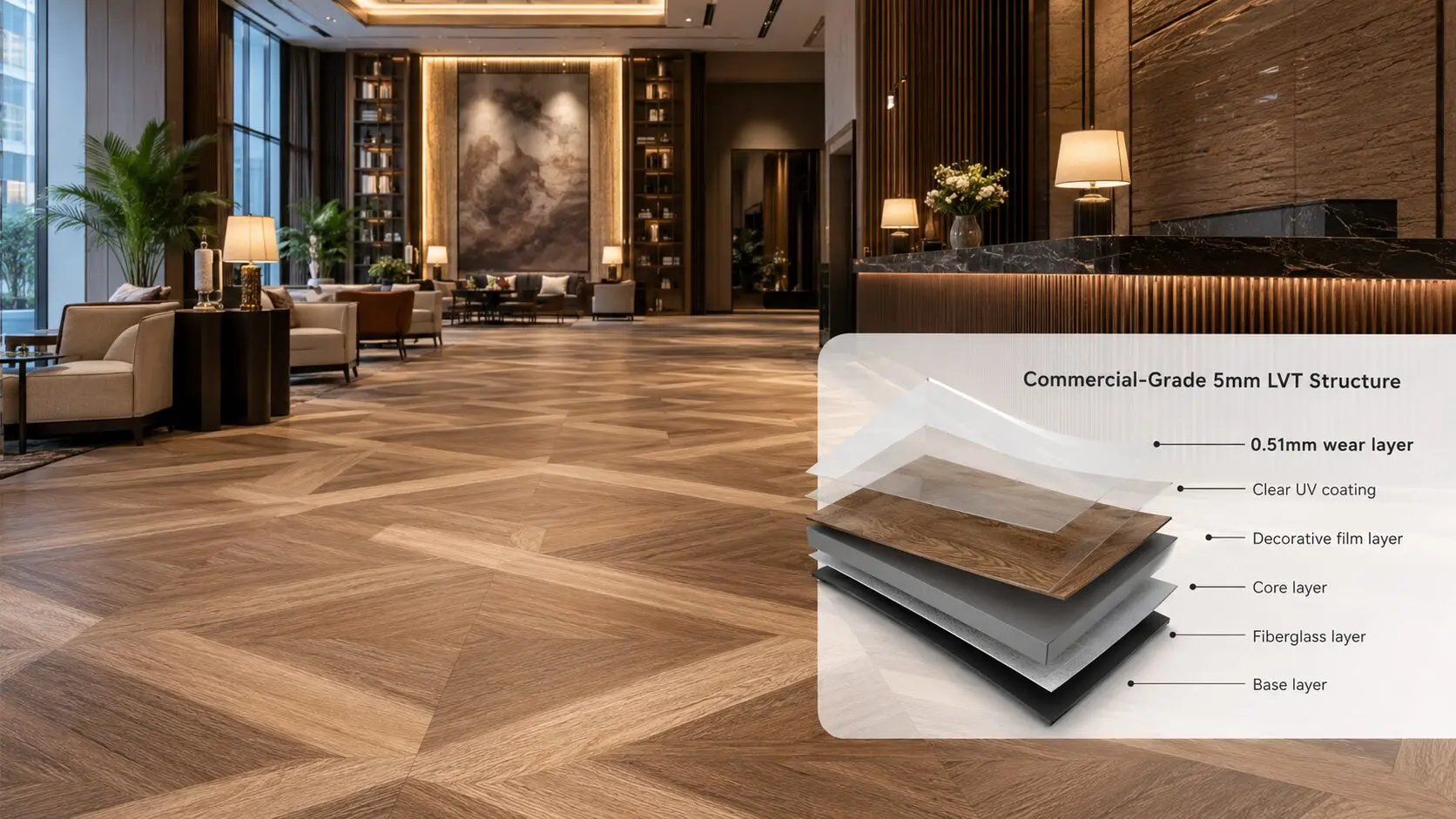
On June 4, 2026, Tarkett Hospitality debuted its Lotus Reserve LVT collection. The product targets high-end hospitality spaces and uses a 5mm overall thickness with a 0.51mm wear layer. It is also positioned for commercial traffic and backed by a limited 15-year commercial warranty.
That tells us something important about the upper side of the market.
Hospitality buyers are not asking only for waterproof claims. They want a surface that looks designed, installs cleanly, and survives traffic.
The old LVT market was simple: wood plank, stone tile, standard size, standard finish.
Now buyers want parquet visuals, interlocking curves, softer geometry, low-repeat patterns, better comfort, and stronger surface performance. This design pressure is already affecting China flooring export 2026 orders.
For factories, that means more production complexity.
More SKUs.
More film matching.
More surface control.
More UV coating stability.
More cutting accuracy.
If a factory is already struggling to hold ±0.10mm tolerance on regular plank, do not expect stable performance on complicated design formats. The more complex the visual system, the more serious the QC must be.
This also explains why Waterproof LVT Click Vinyl Flooring still has room in the market. Good click LVT can serve retail buyers who want faster installation and better design flexibility, while dry back LVT remains strong for project channels.
Factory Yard Note:
For hospitality-style LVT, buyers should check more than the wear layer. Check tile size tolerance, edge squareness, color batch consistency, UV coating cure, and carton mixing rules. A beautiful pattern becomes a headache if batch A and batch B shift by 1 shade under hotel lighting.
News Item 4: Chemical Compliance Is Becoming a Sales Filter
Washington State’s Safer Products rules already restrict ortho-phthalates in vinyl flooring from January 1, 2025. The same compliance page also lists PFAS restrictions for carpets and rugs from January 1, 2025, and further PFAS restrictions in other product categories from 2026 and 2027.
This matters because buyers are getting more careful with chemical documents.
A distributor may ask for FloorScore, REACH, phthalate testing, heavy metal testing, and sometimes PFAS-related declarations. Some buyers do not fully understand the difference between VOC emissions and phthalate content, but they still need paperwork to satisfy their market.
FloorScore is mainly a low-VOC indoor air quality certification. It does not automatically cover phthalate content. That means a buyer should not treat one certificate as proof for everything.
This is where many exporters get lazy.
They send one old test report and hope the buyer stops asking.
That will not work for serious importers in 2026.
Eco-friendly vinyl flooring is no longer just a marketing phrase. It needs traceable resin, stable plasticizer control, proper test dates, and clear batch connection.
For AutoPP Floor, this is why product structure and documentation should be discussed together. A buyer can study factory capability through the AutoPP Floor about us page, but before mass production, the purchase order still needs exact compliance requirements written into the contract.
Factory Yard Note:
Ask for the test report date, sample description, tested thickness, tested color, and lab name. If the report says “vinyl flooring” but does not match your ordered product, do not treat it as batch proof.
What This Means for Importers Buying From China
The market is not dead.
The market is filtering weak suppliers.
Cheap SPC still sells, but the risk is getting higher. If PVC resin cost moves up, compliance pressure rises, and buyers demand better design, the factory has only two choices: upgrade process control or hide cost reduction inside the board.
The hidden reductions are usually in five places:
- Lower SPC core density
- More recycled filler
- Thinner actual wear layer
- Fewer UV coating passes
- Shorter cooling and aging time after extrusion
None of these look obvious on a PDF quotation.
All of them show up after installation.
This is why importers who want to buy SPC flooring from China should treat sampling as an engineering step, not a decoration step.
Do not approve only the color.
Approve the structure.
Do not ask only for FOB.
Ask for the board’s inside story.
If you are buying for retail stores, start with 4.2mm/0.3mm or 5.0mm/0.5mm depending on price lane. If you are buying for commercial or apartment distribution, 5.5mm + 1.5mm IXPE gives better comfort and stronger perceived value. If the project is garage, workshop, warehouse corner, or modular utility area, Interlocking Garage Floor Tiles may be more suitable than forcing SPC into the wrong job.
Buyer Checklist Before Placing Q3 Orders
Before paying deposit, ask these 10 questions:
- What is the actual SPC core density?
- Is the resin virgin, recycled, or mixed?
- What is the real wear layer thickness after measurement?
- How many UV coating layers are applied?
- What click system is used?
- Has the board passed heat stability testing?
- How long is the aging time before profiling?
- Is IXPE density specified or only thickness specified?
- Are compliance reports valid for this exact product?
- Will the factory allow random carton inspection before loading?
If the supplier answers clearly, continue.
If the supplier only says “quality very good,” slow down.
Good factories know their numbers.
Weak factories hide behind adjectives.
Closing Factory Comment
This week’s news points in one direction: resilient flooring is becoming more technical again.
The easy money period of selling any SPC board with a waterproof label is fading. Importers are becoming more experienced. Retailers are tired of claims. Builders are watching cost. Hospitality buyers want design and durability together. Regulators are asking harder questions.
For China flooring export 2026, this is not bad news.
It is good news for factories that actually control extrusion, UV coating, click profiling, aging time, and documentation.
It is bad news for suppliers living only on cheap quotes.
AutoPP Floor will keep focusing on practical export specifications: stable SPC, usable LVT, clear compliance files, and honest production communication. Buyers planning new programs can contact the team through AutoPP Floor contact page with target market, thickness, wear layer, backing, and expected container volume.
Published by AutoPP Floor | Zhangjiagang, Jiangsu, China