China Flooring News: Stair Treads, Builder Pressure and Material Health Are Reshaping SPC & LVT Orders
Published: June 17, 2026 | autoppfloor.com | Zhangjiagang, Jiangsu, China
Category: Flooring Industry News
Market Desk: AutoPP Floor Export Intelligence
News Lead
The flooring market gave Chinese exporters a different signal this week. It was not only about SPC price, LVT design, or PVC resin. The bigger change is happening around complete flooring systems: stairs, builder affordability, healthcare material health, and specification discipline.
For importers, this means one thing: buying flooring by square meter alone is becoming outdated. Buyers now need to think by application zone — room, stair, corridor, bathroom, apartment, retail shop, hospital, garage, and replacement cycle.
That is where the real China flooring export 2026 opportunity sits.
1. Stair Treads Are Becoming Part of the Flooring System, Not an Afterthought
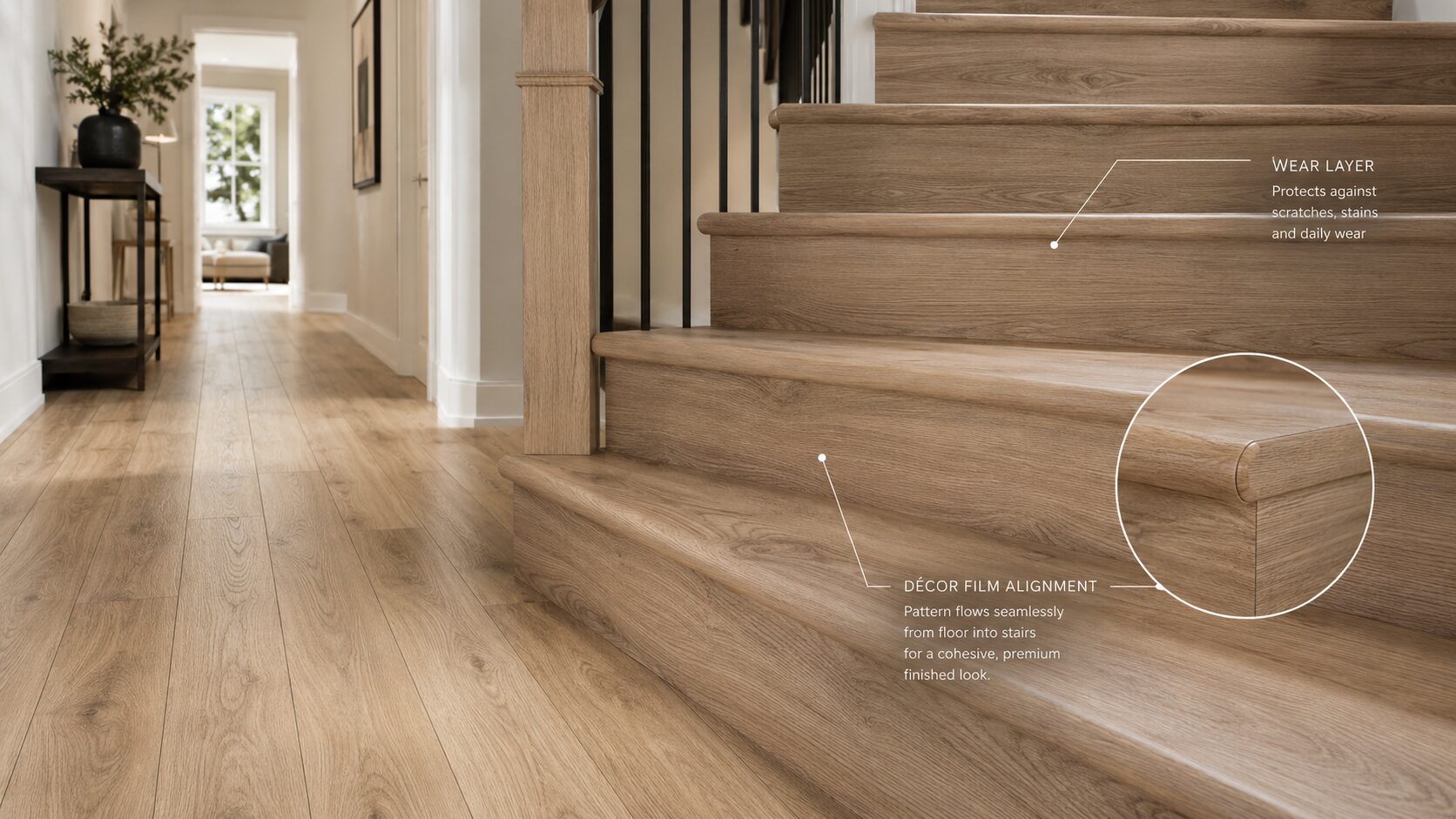
Recent industry coverage shows i4F moving deeper into stair tread technology. The key idea is simple but important: the stair tread should match the floor in décor, gloss, texture, wear layer, and long-term performance.
From the factory side, this is a very practical topic.
Many importers still buy flooring first and worry about stairs later. That creates problems:
- The plank color does not match the stair nose.
- Gloss level shifts under daylight.
- Texture direction looks wrong.
- The stair edge wears faster than the main floor.
- Homeowners notice the mismatch every day.
In SPC and LVT export orders, stairs are no longer a small accessory problem. They affect the whole project look.
A 5.5mm SPC plank with 1.5mm IXPE may perform well in the living room, but if the stair tread is made from a different batch, different film, or different surface finish, the project loses value. Buyers selling to builders and renovation contractors should treat stair treads as part of the same product family.
For factories, this means tighter film control, clearer batch coding, and better accessory planning. For buyers, it means the purchase order should not only say “SPC flooring.” It should also define trims, stair noses, reducers, T-moldings, skirting, and packaging sequence.
If your market sells complete home renovation packages, start product planning from the full AutoPP Floor product range, not only one SPC item.
Factory Translation
The stair area takes more abuse than the center of the room. Foot pressure concentrates on the edge. If the wear layer is weak or the profile is poorly formed, the failure appears quickly.
For residential projects, 4.2mm/0.3mm SPC can work when the jobsite is normal and price is controlled. For stronger renovation packages, 5.5mm + 1.5mm IXPE gives better hand feel and better perceived value. When stairs are included, the buyer should confirm accessory color matching before mass production, not after loading.
Buyers sourcing from AutoPP Floor SPC flooring should send staircase details together with room size, thickness, wear layer, backing, and market price lane.
2. Builder Sentiment Is Weak, So Flooring Buyers Are Getting Tougher
North American builder confidence remains under pressure because affordability is still tight. When builders feel pressure, they do not stop buying flooring. They start asking harder questions.
That pressure flows backward through the supply chain.
A builder wants lower installed cost.
A distributor wants fewer claims.
A retailer wants easier selling points.
A factory wants stable production volume.
The problem is that these goals do not always match.
If a buyer only pushes for cheaper SPC, the factory may respond by reducing density, increasing recycled filler, shortening aging time, or thinning the real wear layer. The quotation looks good. The floor may not.
This is where experienced importers separate themselves from beginners.
They do not ask, “What is your cheapest waterproof floor?”
They ask:
- What is the actual density?
- What is the real wear layer?
- How many UV coating passes?
- What click system is used?
- What is the IXPE density?
- How many days from extrusion to profiling?
- Can this structure survive the target market?
For builder channels, product choice should match project economics. LVT Dry Back Glue Down Flooring can be a smart option for apartment turns, multifamily buildings, rental housing, and commercial areas where subfloor control is good. It is easier to repair by section and can reduce floating-floor issues in large areas.
Floating SPC is still strong for residential retail, DIY renovation, and waterproof marketing. But dry back LVT should not be ignored just because SPC is louder in the market.
Factory Translation
When builders cut costs, flooring suppliers are tested.
A low-cost product is not automatically bad. But a low-cost product without technical limits is dangerous. For export buyers, every budget line needs a safety line:
- Minimum density
- Minimum wear layer
- Minimum click strength
- Minimum UV performance
- Minimum batch consistency
The factory should know these numbers. If it does not, the buyer is gambling.
3. Material Health Is Moving From Marketing Claim to Procurement Filter
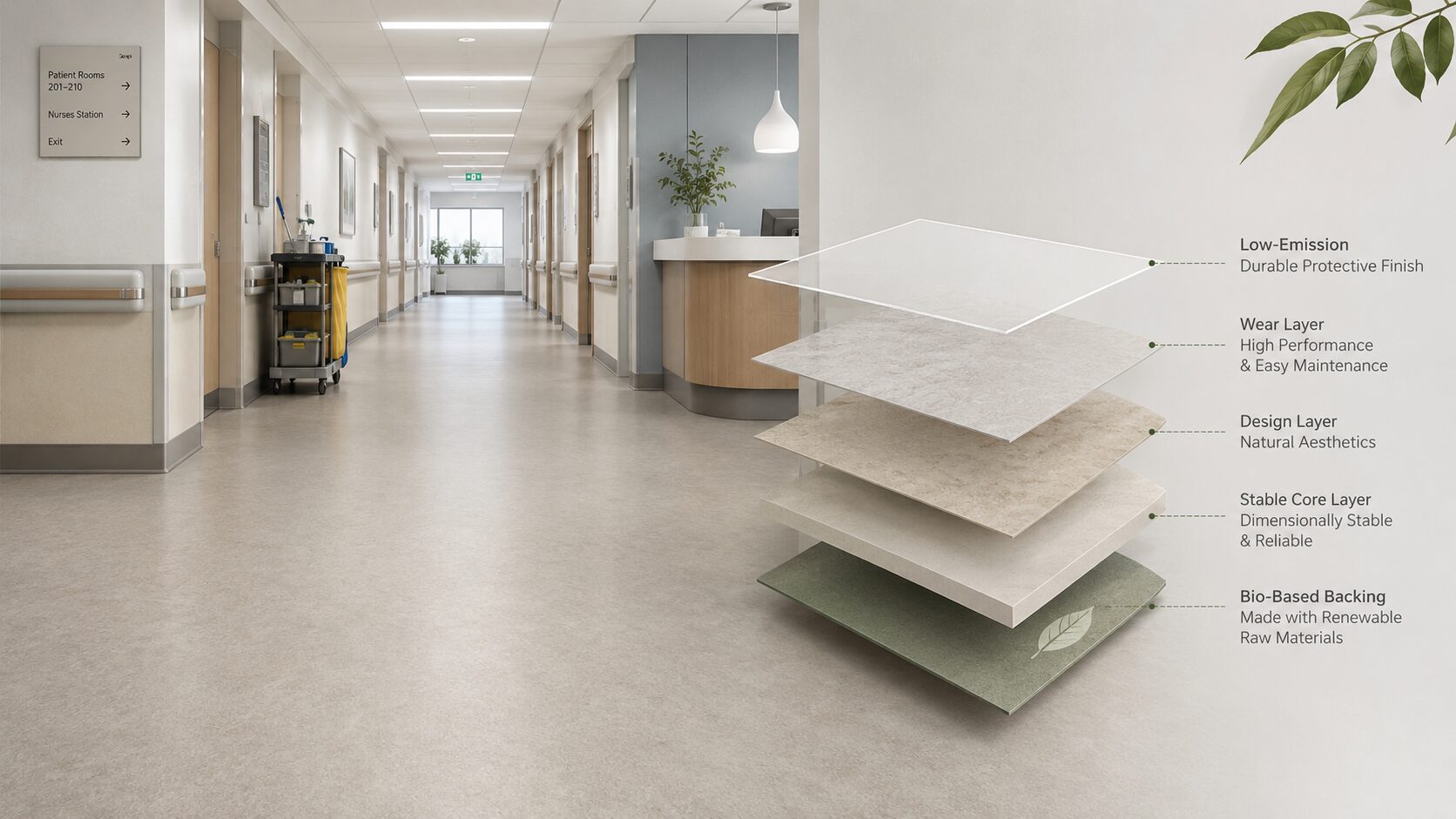
Healthcare flooring news this week highlighted a bio-based polyurethane floor receiving a Greenhealth-related approval. That story is not directly about SPC, but it matters to vinyl flooring exporters.
Why?
Because buyers are asking more questions about material health.
Hospitals, schools, senior living centers, offices, hotels, and public buildings are all becoming more careful. They want floors that are easy to clean, low emission, durable, and traceable.
This creates pressure on traditional PVC flooring suppliers.
For Eco-friendly vinyl flooring, buyers are no longer satisfied with broad claims like “green,” “safe,” or “non-toxic.” They want documents and product logic.
SPC and LVT suppliers should prepare:
- VOC emission documents
- REACH-related files
- Phthalate testing
- Heavy metal screening
- Batch traceability
- Raw material descriptions
- Clear product structure sheets
This does not mean PVC flooring will disappear. That is not how the market works. PVC-based LVT and SPC still have strong advantages in waterproof performance, dimensional stability, price range, and design flexibility.
But the easy marketing period is ending.
A factory that can explain material structure clearly will win more serious buyers than a factory that only sends a low FOB price.
For project buyers comparing click products, Waterproof LVT Click Vinyl Flooring can serve retail and renovation channels where faster installation and flexible design matter. For healthcare or commercial areas, the buyer should be more careful about surface cleanability, glue system, VOC requirements, and maintenance cycle.
Factory Translation
A compliance document is useful only when it matches the ordered product.
If a buyer orders 5.0mm LVT click in oak color, do not accept a random old report for “vinyl flooring sample.” Ask whether the test report matches the construction, thickness, surface coating, and production batch.
Good compliance is not a PDF folder.
Good compliance is a production habit.
4. PVC Prices Are Softer, But That Does Not Mean Cheap Flooring Is Safe
Polyvinyl pricing moved lower this month, which gives buyers some room in negotiation. But lower PVC price does not automatically mean all SPC quotations are safe.
This is where many buyers misunderstand the factory cost structure.
PVC resin is important, but SPC flooring cost also includes:
- Calcium carbonate
- Stabilizer
- Decorative film
- Wear layer
- UV coating
- IXPE backing
- Carton and pallet
- Labor
- Electricity
- Tooling
- Waste rate
- Inland transport
If a supplier suddenly offers a price much lower than the market, the reason is usually not only PVC price. The hidden changes may be inside the product.
A factory may reduce UV coating.
A factory may use a lower-density core.
A factory may make the click thinner.
A factory may lower IXPE quality.
A factory may shorten cooling time.
That is why buying only by PVC trend is risky.
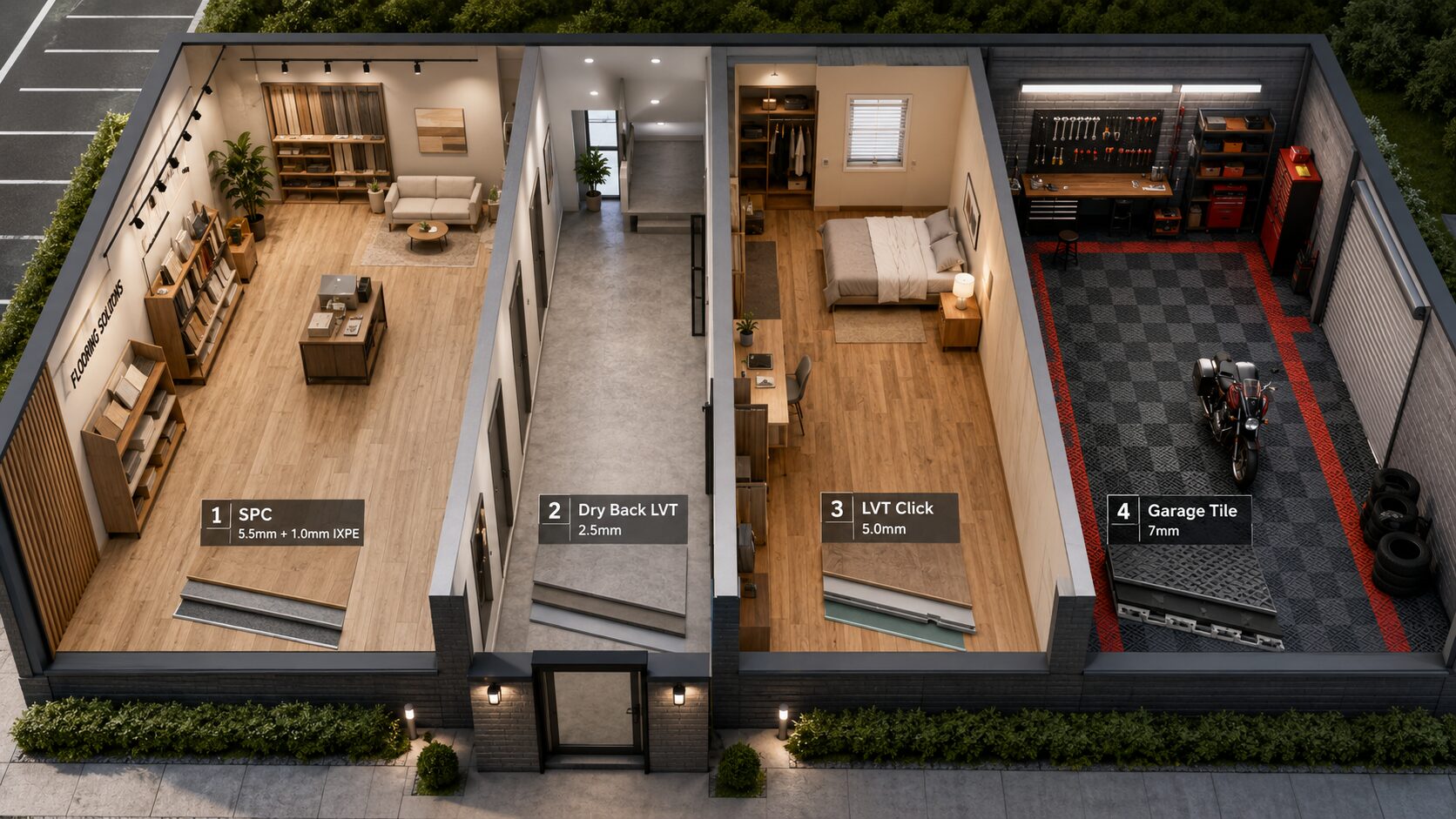
For standard residential distribution, 4.2mm/0.3mm is still a practical baseline. For better channels, 5.0mm/0.5mm or 5.5mm + 1.5mm IXPE is more stable. For garages, workshops, storage rooms, and utility areas, Interlocking Garage Floor Tiles may be more suitable than forcing SPC into a heavy-impact environment.
Factory Translation
PVC price gives room to talk.
It does not replace inspection.
If the quotation drops 5%, ask why.
If the quotation drops 12%, cut the sample.
If the quotation drops 20%, check everything.
The core tells the truth.
Importer Action Map
| Buying Situation | Better Product Direction | What to Verify Before Deposit |
|---|---|---|
| DIY residential retail | 4.2mm/0.3mm SPC or LVT click | Click strength, surface finish, carton label |
| Apartment renovation | Dry back LVT or stable SPC | Subfloor condition, wear layer, batch color |
| Builder package | SPC with full accessories | Stair tread, trims, batch matching |
| Commercial corridor | Dry back LVT or 5.5mm SPC | Wear layer, UV coating, rolling load |
| Healthcare/public space | Low-emission resilient flooring | VOC, phthalate, cleanability, documentation |
| Garage/workshop | Interlocking garage tiles | Impact resistance, modular replacement |
| Premium retail display | Digital printing SPC flooring | Pattern repeat, EIR texture, UV stability |
| Hot climate market | High-density SPC | Thermal stability, expansion gap, IXPE quality |
Old Factory Advice for Q3 Orders
Do not approve only color.
Approve structure.
A showroom sample can be beautiful and still be weak. A catalog can say waterproof and still fail near a window. A supplier can say virgin material and still mix unstable recycled filler.
For Q3 2026 orders, buyers should write these 8 items into the purchase order:
- Product thickness
- Wear layer
- SPC core density
- IXPE thickness and density
- Click system
- UV coating requirement
- Compliance documents
- Loading inspection rule
That is how you reduce claims.
Not by luck.
By control.
Buyers who want to compare SPC, LVT click, dry back LVT, garage tiles, and export packaging options can review AutoPP Floor and the AutoPP Floor factory background before sending a project brief. For quotations, send market, use area, thickness, wear layer, backing, annual volume, and target price through the AutoPP Floor contact page.
Published by AutoPP Floor | Zhangjiagang, Jiangsu, China