News Brief 1: SPC's "Measured Comeback" — The Quality Reset Is Real
Source: Floor Covering News — “SPC: Meteoric Rise to Measured Comeback” | Published: April 9, 2026
According to Floor Covering News, published April 9, 2026, SPC flooring is undergoing a significant market correction after years of quality inconsistency. Jerry Guo, CEO of Lions Floor, stated: “SPC faced challenges as rapid category growth brought an influx of inconsistent product quality into the market — that created hesitation at retail.” Mohawk’s Adam Ward was blunter: “The problem was never SPC; it was low-quality SPC.”
We’ve been watching this correction from Zhangjiagang for the past 18 months, and frankly, it’s overdue. Between 2021 and 2023, the market saw hundreds of Chinese factories — many with zero flooring background — pivot to SPC production chasing margins. The result? 3.5mm thin-core products with 6-mil wear layers being marketed as “commercial grade.” That’s not commercial grade — that’s a liability.
At our Zhangjiagang facility, we never went below 5.5mm core + 0.5mm wear layer for residential SKUs, and 6mm core + 0.7mm wear layer for semi-commercial lines. The dimensional stability difference between a 4mm and 5.5mm SPC plank under thermal cycling (say, Arizona summers) isn’t marginal — it’s the difference between a 2-year and a 10-year floor. Buyers who got burned on thin-core product are now asking for factory QC documentation upfront. Good. That’s exactly the conversation we want to have.
What FCNews doesn’t fully capture is the factory-side story: the price differential between a compliant 5.5mm SPC and a low-spec 3.5mm product is about $0.18–$0.25/sqft ex-factory. That gap sounds small, but on a 50,000 sqft container order, it’s $9,000–$12,500. Buyers who tried to save that delta on FOB price often spent 3–5x that amount on callbacks, re-installations, and retailer credits. The math was never in their favor.
The retailers rebuilding trust in SPC are now specifying minimum thresholds in their purchase orders: minimum 5mm core, 12-mil wear layer for residential, 20-mil for light commercial. If your current China supplier can’t show you a third-party test report for dimensional stability (EN ISO 23999) and formaldehyde content (CARB P2 / FloorScore), walk away. Our rigid core SPC flooring line ships with full third-party certification documentation as standard.
From our inquiry data in Q1 2026, RFQs specifying “premium spec” with documentation requirements are up 38% year-over-year. The race to the bottom is ending — not because factories suddenly grew a conscience, but because buyers got smarter.
News Brief 2: WPC and Hybrid Rigid Core Take Center Stage at Surfaces 2026
Source: Floor Covering News — “Surfaces ’26: WPC, Hybrids Tackle Performance, Realism” | Published: March 11, 2026
According to Floor Covering News, published March 11, 2026, suppliers at TISE/Surfaces 2026 showcased new WPC and hybrid rigid core floors emphasizing comfort underfoot, design realism, and improved acoustic performance. New WPC collections now feature 30-mil wear layers and attached natural cork or IXPE backings. AHF Products launched its High Density Polymer Core (HDPC) line, producing roughly half of domestic U.S. rigid core demand from its Cartersville, Georgia facility with over 200 million square feet of annual capacity.
The WPC vs SPC debate has matured significantly. Two years ago, the trade show conversation was “SPC is replacing WPC.” At Surfaces 2026, the narrative shifted: WPC isn’t dead — it’s repositioning upmarket.
Here’s what we’re seeing from our export order mix: WPC orders as a percentage of our total production went from 22% in 2024 to 31% in Q1 2026. The growth is coming from specific segments — basement applications, acoustic-sensitive multi-family projects, and markets like Scandinavia and Canada where underfloor heating is standard. In those use cases, WPC’s softer core and better thermal insulation genuinely outperforms SPC.
The “hybrid” category is where it gets interesting from a manufacturing perspective. What brands are calling “hybrid” at trade shows is essentially a WPC board with a denser, more SPC-like core — targeting the acoustic benefit of WPC with dimensional stability closer to SPC. We’ve been producing this construction for 14 months for two European private label clients. The core formulation runs approximately $0.08–$0.12/sqft more than standard WPC to produce, but commands a $0.30–$0.45/sqft premium at retail.
The 30-mil wear layer mention is significant. Standard U.S. residential SPC runs 12-mil. Moving to 30-mil is a statement about longevity positioning. From a sourcing perspective: if a supplier quotes you “30-mil wear layer WPC” at the same price as your current 12-mil SPC, ask for verification. True 30-mil AT-certified product has a cost floor that can’t be cheated. For projects where waterproof LVT click flooring or floating installation is required, these hybrid constructions are worth the premium — the acoustic improvement over standard SPC is measurable (typically 18–22 dB IIC improvement with IXPE backing).
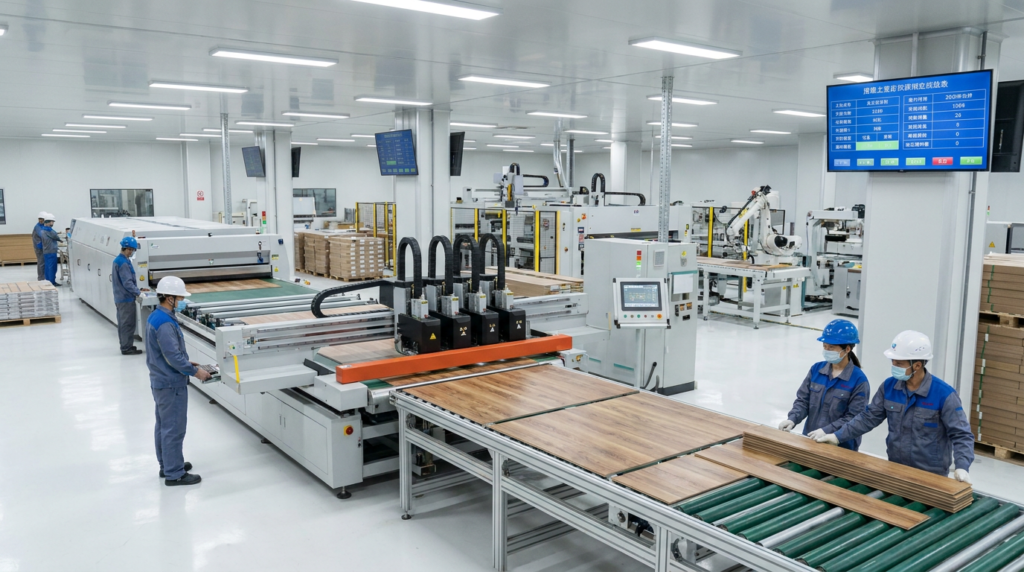
Digital printing is the other tailwind. At our facility, we upgraded to a 6-color UV digital print line in late 2024. Plank repeat length went from 1.2m (standard rotogravure) to 3.6m, making the visual repeat nearly invisible in real room installations. Sample approval rate on new designs went from 67% to 89% after the upgrade.
News Brief 3: China's Flooring Export Faces Dual Pressure — But Premium SPC Holds
Source: SunSirs — “Analysis of China’s PVC Flooring Export Data” | Published: April 23, 2026
According to SunSirs, published April 23, 2026, China’s PVC flooring export volume in January 2026 stood at 393,000 tons, representing a year-on-year decrease from 2025. Meanwhile, China’s overall floor covering market is projected to grow from USD 1.29 billion in 2025 to USD 1.36 billion in 2026 (Mordor Intelligence, January 2026), driven by domestic renovation demand even as US tariff headwinds persist.
Let’s be direct about the tariff situation: Section 301 tariffs on Chinese flooring (HTS 3918) remain in the 25–30% range for most SPC/LVT products entering the US market. What has changed is how factories and importers are responding.
Three strategies dominate our buyer conversations right now. First, Vietnam transshipment — compliance risk is real, and CBP enforcement has intensified. We don’t recommend it. Second, cost engineering — stripping spec to absorb tariff impact on landed price. This is how thin-core product proliferated; avoid it. Third, tariff engineering via product classification — certain WPC constructions can be classified differently from standard SPC under HTS, potentially accessing lower duty brackets. Worth a conversation with your customs broker. For glue-down commercial projects specifically, our LVT dry-back glue-down flooring often falls under a more favorable classification than floating SPC.
For markets outside the US, the picture is genuinely better. EU demand for CARB P2 / CE-certified SPC remains strong. Our inquiry volume from Germany, Netherlands, and Poland is up 22% YoY in Q1 2026. Australian and New Zealand buyers are showing accelerated growth — the ABCB alignment with ISO rigid core standards has filtered out cheap product and benefits compliant manufacturers.
The 393,000-ton January export figure is a dip, but context matters: January is Chinese New Year month, factories run at 40–60% capacity. Our order book for Q2 2026 is the strongest since Q3 2022. The buyers are back — they’re just buying smarter. And one segment most importers overlook: interlocking garage floor tiles are emerging as a high-margin add-on category, with B2B inquiry volume up 44% from North American warehouse and commercial gym buyers.
Key Data Points
- North America SPC flooring market CAGR: 13.7% (2026–2031, GlobeNewswire)
- China PVC flooring export volume, January 2026: 393,000 tons (SunSirs, April 2026)
- China floor covering market: USD 1.29B (2025) → USD 1.36B (2026) (Mordor Intelligence)
- WPC share of AutoPP Floor export production: 22% (2024) → 31% (Q1 2026)
- Premium spec RFQs with documentation requirements: +38% YoY (Q1 2026, internal)
- EU market inquiry volume (DE/NL/PL): +22% YoY, Q1 2026
- Garage floor tile B2B inquiries (North America): +44% YoY, Q1 2026
- Standard residential SPC minimum spec: 5mm core, 12-mil wear layer
- Light commercial SPC minimum spec: 6mm core, 20-mil wear layer
- Digital print line upgrade: plank repeat 1.2m → 3.6m, sample approval rate 67% → 89%
- US Section 301 tariff on Chinese SPC/LVT (HTS 3918): 25–30%
Buyer FAQ
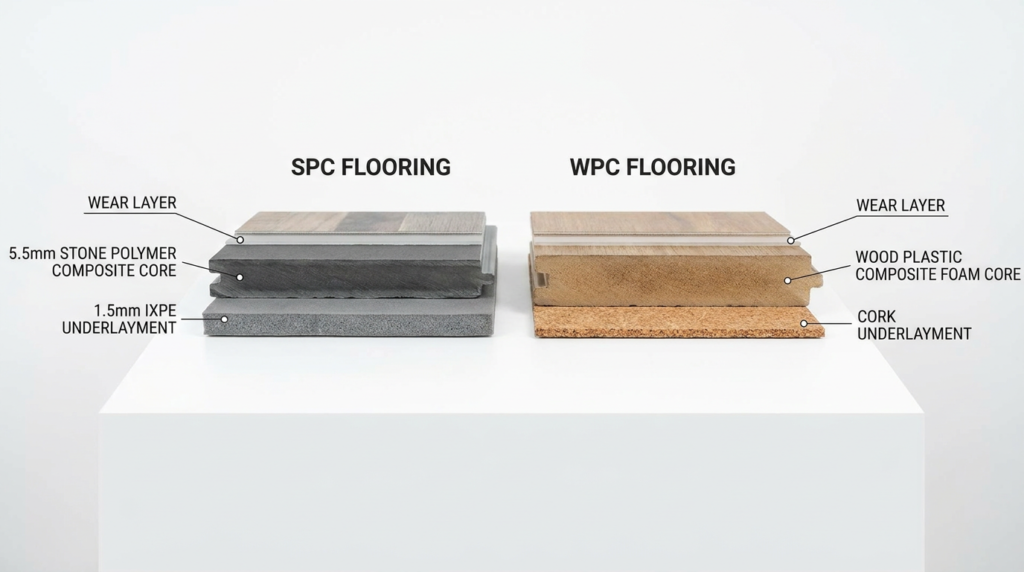
For standard residential (bedroom, living room, kitchen), 5.5mm core with 1.5mm IXPE underlayment is the current benchmark. For basement or below-grade applications, consider 6mm+ SPC or switching to WPC. Avoid anything under 5mm — dimensional stability is insufficient for temperature-variable climates. See our SPC flooring collection for spec sheets on each product line.
At specification-equivalent levels, Chinese SPC from certified factories is indistinguishable in performance from European-branded product — because much of the European-branded product is manufactured in China anyway. The real question is which factory, and what certifications. Look for FloorScore, CARB P2, CE marking (EN ISO 10582), and independent dimensional stability test reports. Learn more about our factory and the certification standards we maintain.
At comparable quality levels, WPC typically runs $0.15–$0.28/sqft higher than SPC ex-factory. Mid-range SPC (5.5mm, 12-mil, EIR surface) from a Zhangjiagang factory: approximately $0.68–$0.82/sqft FOB. Equivalent-spec WPC: $0.85–$1.08/sqft FOB. If a supplier quotes WPC at SPC prices, spec has been compromised somewhere. Contact us with your project specs for a transparent, itemized quote.
References
- Floor Covering News — “SPC: Meteoric Rise to Measured Comeback” (April 9, 2026): https://www.fcnews.net/2026/04/spc-meteoric-rise-to-measured-comeback/
- Floor Covering News — “Surfaces ’26: WPC, Hybrids Tackle Performance, Realism” (March 11, 2026): https://www.fcnews.net/2026/03/surfaces-26-wpc-hybrids-tackle-performance-realism/
- SunSirs — “Analysis of China’s PVC Flooring Export Data” (April 23, 2026): https://www.sunsirs.com/commodity-news/petail-32346.html
- GlobeNewswire — “Floor Coverings Market 2026–2031” (January 21, 2026): https://www.globenewswire.com/news-release/2026/01/21/3222503/0/en/floor-coverings-market-2026-2031
- Mordor Intelligence — “China Floor Covering Market Size & Share” (January 2026): https://www.mordorintelligence.com/industry-reports/china-floor-covering-market
Published by AutoPP Floor | Zhangjiagang, Jiangsu, China All factory data points reflect internal AutoPP Floor production and inquiry records, Q1 2026.