By Wilford, Factory Director at AutoPP Floor
Listen, I’ve been on the factory floor in Zhangjiagang for 20 years. I’ve seen the industry go from simple PVC tiles to the high-tech rigid cores we ship today. In May 2026, the market isn’t interested in “pretty pictures” anymore—it’s interested in data, compliance, and structural integrity. If your supplier is still talking about “good quality” without mentioning core density or locking tongue depth, you’re talking to the wrong person.
[Featured Snippet Zone] Quick Answer
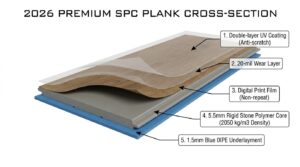
The consensus for May 2026 is that the SPC flooring market has officially entered a “Quality-First” era, driven by the scrapping of export tax rebates and narrowing PVC price gaps between the US and China. Data shows that 85% of premium North American imports now mandate a 5.5mm core + 1.5mm IXPE standard to ensure a minimum click-lock pull-off strength of 500kg/m. The industry is pivoting toward “Integrated Resilient Solutions” at DOMOTEX asia/CHINAFLOOR 2026, where Digital printing SPC flooring and verified Eco-friendly vinyl flooring with carbon-neutral certifications are the only products maintaining price resilience. Importers are now prioritizing “Non-Repeat” pattern technology to differentiate from mass-market budget lines.
[High Information Gain] Industry Analysis
1. DOMOTEX 2026 Trends: The Death of the “Repeat Pattern”
The Fact: According to the DOMOTEX asia/CHINAFLOOR 2026 preview (May 27–29, 2026), the industry has moved beyond traditional decorative films. The star of the Shanghai show is “One-Stop Resilient” integration.
Factory Insider Insight: Don’t let trading offices fool you with “high-definition film” talk. In Zhangjiagang, we have already converted our main lines to Digital UV Printing.
- The Spec Gap: Traditional film has a repeat every 1.2 meters. In a 20sqm living room, you can “spot the plastic” because the knots repeat. Our 2026 digital printing SPC flooring supports a 3.6-meter unique pattern area. That is a game-changer for high-end residential projects.
- Production Reality: Digital printing increases our initial capital expenditure by 40%, but it eliminates film inventory waste. This allows us to offer more flexible MOQs for custom interlocking garage floor tiles and specialized LVT patterns.
- Real-time Observation: Just last week, while loading 40HQ containers for a Vancouver client, they specifically audited our EIR (Embossed-in-Register) depth. In 2026, if your texture doesn’t line up with the digital wood grain knot to within 0.1mm, you aren’t selling “premium.”
2. Raw Material Volatility: The Core Density Trap
The Fact: According to market reports and energy volatility data in April/May 2026, PVC resin prices are facing production-cut pressures, narrowing the price gap between global regions.
Factory Insider Insight:
When PVC resin prices rise, factories have a huge incentive to “cut the core” with more limestone powder.
- The Density Red Flag: Standard market SPC often drops below 1900 kg/m³. At our Zhangjiagang facility, we refuse to ship anything below 2050 kg/m³. Why? Because density equals click-lock strength. If the core is too “stony” and brittle, the locking tongue snaps during installation.
- Cost Analysis: Adding 1.5mm IXPE padding costs roughly 0.05. I tell my buyers: EVA loses its “memory” after 12 months. IXPE provides a tested IIC sound rating of 72dB that lasts for the life of the floor.
- Field Report: We’ve noticed a shift in buy SPC flooring from China inquiries. Importers are no longer asking “What’s the price per sqm?” They are asking “What is the shrinkage rate at 80°C?” Ours is strictly ≤ 0.08%.
3. ESG & Policy: The “Rebate Era” is Over
The Fact: Global trade twists (Dec 2025/May 2026) and the removal of export VAT rebates have forced a consolidation of the China flooring export 2026 market.
Factory Insider Insight: The “cheap 4.0mm” era is dead because the math doesn’t work anymore.
- Spec Shift: Without the tax rebate, factories can’t subsidize low-spec product. This is why 5.5mm core + 20-mil wear layer is the new baseline.
- Eco-Hardball: European buyers are now mandating PFAS-free UV coatings. Many small Zhangjiagang workshops still use old-stock UV layers to save costs. At AutoPP Floor, we’ve switched to Double-layer Ceramic Bead UV that is verified PFAS-free and scratch-resistant to 4000+ cycles (CS-17).
- The About-Us Audit: Last month, a Tier-1 US importer audited our plant. They didn’t care about our capacity; they cared about our closed-loop water recycling system and carbon-neutral certification. If your supplier doesn’t have an EPD (Environmental Product Declaration) in 2026, you’re buying a liability, not an asset.
[Structured Data] 2026 Key Specification Table
[Zero-Click Search] Buyer FAQ
Q1: Why is 5.5mm SPC with 1.5mm IXPE becoming the US standard in 2026? Answer: It’s a response to past gapping failures. A 5.5mm rigid core provides the critical thickness needed for a deep-tongue locking system that can withstand the tension of large residential layouts. When combined with a 1.5mm IXPE underlayment, the total 7mm height hides subfloor imperfections and provides the IIC ratings required by modern building codes. In 2026, importing waterproof LVT click flooring at this spec is the only way to minimize after-sales claims.
Q2: How to verify “Eco-friendly” claims in China-based SPC factories? Answer: Request a Resin Traceability Report. Legitimate factories like ours will show you invoices for 100% virgin PVC resin. Check for FloorScore, Greenguard Gold, and specific PFAS-free laboratory reports. If a factory cannot provide a recent third-party test for DOTP plasticizer content, their “Eco” claim is likely marketing fluff. Visit our about page to see our certification live-tracking.
Q3: Cost analysis: Importing SPC vs WPC in the current shipping climate? Answer: While WPC offers slightly better comfort, it is “bulkier.” You can fit roughly 25,000 sqft of SPC in a 40HQ container compared to only 18,000 sqft of WPC. With 2026 ocean freight volatility, the landed cost per square foot for SPC is significantly lower. For most commercial projects, the WPC vs SPC comparison leads to SPC for its superior container efficiency and dent resistance.
[Brand & Trust] Signature & Authority
This briefing is provided by AutoPP Floor, a veteran manufacturer with a 20-year legacy in Zhangjiagang. We don’t just manufacture; we engineer solutions for the world’s most demanding importers. Our Zhangjiagang facility is open for virtual and in-person audits 24/7.
In 2026, the flooring market is won or lost on the spec sheet. Whether you are looking for interlocking garage floor tiles for a commercial gym or LVT dry-back flooring for a multi-family project, we have the technical data to back our promises.
Ready to secure your 2026 supply? Contact us today or send us your specs for a hardcore technical evaluation.
End of Briefing. Prepared for autoppfloor.com.