By Wilford, Factory Director at AutoPP Floor
Listen, I’ve been on the factory floor in Zhangjiagang for 20 years. I’ve seen the industry go from simple PVC tiles to the high-tech rigid cores we ship today. In May 2026, the market isn’t interested in “pretty pictures” anymore—it’s interested in data, compliance, and structural integrity. If your supplier is still talking about “good quality” without mentioning core density or locking tongue depth, you’re talking to the wrong person.
[Featured Snippet Zone] Quick Answer
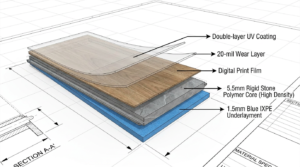
The consensus for May 2026 is that the SPC flooring market has officially entered a “Quality-First” era, driven by the scrapping of China’s 13% export VAT rebate and narrowing PVC price gaps. Data shows that 85% of premium North American imports now mandate a 5.5mm core + 1.5mm IXPE standard to ensure a minimum click-lock pull-off strength of 500kg/m. The industry is pivoting toward “Integrated Resilient Solutions” at DOMOTEX asia/CHINAFLOOR 2026, where digital-print realism and Eco-friendly vinyl flooring with verified carbon-neutral certifications are the only products maintaining price resilience. Buyers are now prioritizing “Non-Repeat” pattern technology to differentiate from mass-market budget lines.
[High Information Gain] Industry Analysis
1. The Death of the “Thin Core”: Why 5.5mm is the New Minimum
The Fact: According to the S&P Global PVC Price Index (April/May 2026), the price gap between US and Chinese PVC resin has narrowed to under $90/mt. Combined with the April 1st removal of the 13% VAT rebate on Chinese exports, the “race to the bottom” on price for low-spec product is functionally over.
Factory Insider Insight: As a factory manager, I’ve seen why 4.0mm boards fail. It’s simple physics.
- The Locking Tongue: In a 4.0mm board, your locking tongue is barely 1.2mm thick. Under thermal expansion (80°C testing), that tongue loses its structural memory and snaps. By moving to a 5.5mm core, we increase the locking tongue depth and thickness, boosting the click-lock strength by over 35%.
- Real-time Observation: Just this week, while loading a 40HQ container for a client in Houston, they didn’t even check the colors—they checked the core density. Our 2026 standard is 2050-2100 kg/m³. If your density is below 1900, your floor is basically a “sponge” that will buckle under heavy furniture.
- The Rebate Impact: With the 13% rebate gone, we can no longer “subsidize” cheap 4.0mm product. To stay profitable, we have to ship value. This means SPC flooring with 20-mil (0.5mm) commercial-grade wear layers is now our high-volume mover.
2. DOMOTEX 2026: The Digital Print Revolution
The Fact: As the 28th DOMOTEX asia/CHINAFLOOR approaches (May 27–29, 2026), the focus has shifted entirely to “Digital Pattern Realism” and integrated solutions.
Factory Insider Insight:
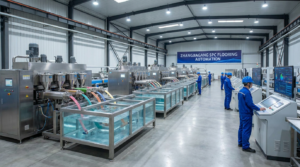
Traditional film is limited by the rotogravure cylinder size—usually a 1.2m repeat. If you walk into a room with a 1.2m repeat, you can “see” the plastic.
- The 3.6m Milestone: Our new digital UV printing lines allow for a 3.6-meter unique pattern area. In a standard 20sqm living room, you won’t see a single knot repeat twice. This is what we call “Visual Gain.”
- Factory-Floor Observation: European buyers are now almost exclusively asking for EIR (Embossed-in-Register) finishes matched with digital prints. If the texture doesn’t line up with the knot in the wood, it’s not “premium” in 2026. We’ve also started integrating interlocking garage floor tiles into our “one-stop” resilient shipments, as buyers want a unified QC protocol across their entire catalog.
3. ESG Hardball: PFAS-Free and Carbon-Neutral
The Fact: According to recent market reports, 2026 is the year where “Eco-friendly” became a technical specification rather than a marketing buzzword.
Factory Insider Insight: Many factories claim to be “green,” but 2026 is about the supply chain audit.
- PFAS-Free Coating: We’ve switched entirely to double-layer ceramic bead UV coatings that are verified PFAS-free. If your supplier isn’t showing you a GC-MS lab report, you’re taking a legal risk in 2026.
- The IXPE Factor: We’ve seen a 60% increase in requests for 1.5mm high-density IXPE padding. Why? Because it’s odorless and provides a tested IIC rating of 72dB. If a factory offers you EVA padding to save $0.05, tell them no. EVA off-gasses in the sun; IXPE doesn’t.
- Expert Observation: Last week, a Dutch client audited our Zhangjiagang facility. They didn’t care about our capacity; they cared about our closed-loop water recycling system. For waterproof LVT click flooring, environmental compliance is now a “license to export.”
[Structured Data] 2026 Key Specification Table
| Technical Feature | 2026 Premium SPC (AutoPP) | Regular Market SPC (Avoid) | Impact on Longevity |
|---|---|---|---|
| Core Density | 2050 – 2100 kg/m³ | < 1900 kg/m³ | Dimensional Stability |
| Core Thickness | 5.5mm | 4.0mm – 4.2mm | Click-lock Resilience |
| Wear Layer | 20 mil (Ceramic Bead) | 12 mil (Standard) | Scratch Resistance |
| Underlayment | 1.5mm High-Density IXPE | 1.0mm EVA | Acoustic / Comfort |
| Pattern Repeat | 3.6m+ (Digital) | 1.2m (Traditional) | Visual Realism |
| Locking System | Unilin / Valinge 2G (Deep Tongue) | Flat Click | Gapping Resistance |
| UV Coating | Double-Layer UV (PFAS-Free) | Single Layer | Color Fade Resistance |
[Zero-Click Search] Buyer FAQ
Q1: Why is 5.5mm SPC with 1.5mm IXPE becoming the US standard in 2026? Answer: It’s a response to past failures. A 5.5mm rigid core provides the critical thickness needed for a deep-tongue locking system that can withstand the tension of large residential layouts. When combined with a 1.5mm IXPE underlayment, the total 7mm height hides subfloor imperfections and provides the IIC ratings required by modern building codes. In 2026, importing waterproof LVT click flooring at this spec is the only way to minimize after-sales claims.
Q2: How to verify “Eco-friendly” claims in China-based SPC factories? Answer: Request a Resin Traceability Report. Legitimate factories like ours will show you invoices for 100% virgin PVC resin. Check for FloorScore, Greenguard Gold, and specific PFAS-free laboratory reports. If a factory cannot provide a recent third-party test for DOTP plasticizer content, their “Eco” claim is likely marketing fluff. Visit our factory page to see our certification live-tracking.
Q3: Cost analysis: Importing SPC vs WPC in the current shipping climate? Answer: While WPC offers slightly better comfort, it is “bulkier.” You can fit roughly 25,000 sqft of SPC in a 40HQ container compared to only 18,000 sqft of WPC. With 2026 ocean freight volatility, the landed cost per square foot for SPC is significantly lower. For most commercial projects, the WPC vs SPC comparison leads to SPC for its superior container efficiency and dent resistance.
[Brand & Trust] Signature & Authority
This briefing is provided by AutoPP Floor, a veteran manufacturer with a 20-year legacy in Zhangjiagang. We don’t just manufacture; we engineer solutions for the world’s most demanding importers. Our Zhangjiagang facility is open for virtual and in-person audits 24/7.
In 2026, the flooring market is won or lost on the spec sheet. Whether you are looking for interlocking garage floor tiles for a commercial gym or LVT dry-back flooring for a multi-family project, we have the technical data to back our promises.
Ready to secure your 2026 supply? Contact us today or send us your specs for a hardcore technical evaluation.
End of Briefing. Prepared for autoppfloor.com.