China Flooring News: Rigid Core Claims, Sustainability Pressure and Global Brand Moves Are Changing SPC Buying in June 2026
Published: June 15, 2026 | autoppfloor.com | Zhangjiagang, Jiangsu, China
Category: Flooring Industry News
Factory desk: AutoPP Floor, Zhangjiagang
Opening Wire
The flooring market gave importers three clear warnings this week. First, rigid core flooring failures are serious enough that the U.S. market is organizing dedicated failure-prevention training. Second, sustainability reporting is moving from marketing language into product engineering and supply-chain discipline. Third, global flooring brands are adjusting leadership and product direction while resilient flooring keeps moving toward better structure, better design and cleaner documentation.
For buyers planning Q3 procurement, the message is simple: do not buy SPC flooring from China only by FOB price. Check the board, the lock, the backing, the paper file and the factory’s ability to repeat the same quality for 3,000 cartons, not only 3 showroom samples.
News Wire 1: Rigid Core Failure Training Is Now a Market Signal
A U.S. flooring inspection and training group announced a dedicated “Preventing Rigid Core Flooring Failures” course scheduled for July 14–15, 2026 in Denver, Colorado. The course focuses on jobsite risk, product selection, relative humidity guidelines, installation conditions, documentation and claims evaluation.
That kind of training does not appear for no reason.
When a product category grows fast, claims follow. SPC, WPC and hybrid rigid core floors expanded quickly because they are waterproof, easy to install and visually strong. But after enough projects, the weak spots become visible.
The usual failure points are not mysterious:
- Weak click edge
- Low-density SPC core
- Poor subfloor preparation
- Heat expansion near windows
- Wrong product used in the wrong site
- Insufficient expansion gap
- Moisture and RH conditions ignored
- Thin boards sold into heavy-use areas
From the factory side, we see the same issue in sample testing. A 3.5mm click SPC with a brittle recycled core may pass a quick showroom check, but repeated installation cycles tell the truth. The click lip starts whitening, then cracking. If the density is below a stable level, the edge behaves like compressed chalk.
For export buyers, rigid core failure is not only an installation problem. It is also a purchasing problem.
A weak product selected for the wrong market will fail even if the installer is careful.
For regular residential channels, 4.2mm/0.3mm is usually the lower safe line. For better apartment, retail and light commercial use, 5.5mm + 1.5mm IXPE gives stronger perceived value and better comfort. For serious traffic, 20 mil wear layer and stable UV coating are not decoration. They are claim protection.
Buyers reviewing product structures can start with AutoPP Floor’s SPC flooring category and compare thickness, backing, wear layer and click profile before confirming container production.
What Buyers Usually Miss
Many importers ask for “Unilin click system” or “Unipush” on the quotation, then stop there.
That is not enough.
The same click name can perform differently depending on core density, profiling precision, tool wear and cooling time after extrusion. If the extrusion line runs too fast, internal stress stays inside the board. If the board is profiled too early, the click system may look clean but become unstable after container heat.
A good factory should explain:
- Extrusion line stability
- Aging time before profiling
- SPC density range
- Click tolerance
- Thermal stability test
- Random carton inspection rule
This is why AutoPP Floor positions factory communication around real specifications instead of empty brochure language.
News Wire 2: Sustainability Reports Are Becoming Engineering Documents
Välinge Innovation released its 2025 Sustainability Report on June 11, 2026. The company highlighted sustainable innovation, resource-efficient production, circularity, reduced environmental impact, net zero ambitions by 2040 and responsible business practices across the value chain.
For many flooring sellers, sustainability still sounds like soft language.
Inside the factory, it is not soft at all.
It affects materials, energy use, coating chemistry, packaging, documentation and customer audits. European and North American buyers are no longer satisfied with “eco-friendly vinyl flooring” written on a catalog page. They want test reports, supplier traceability and clear product claims.
This is especially important for SPC and LVT because both products sit close to chemical compliance questions:
- PVC resin source
- Stabilizer system
- Plasticizer status
- VOC emission
- Phthalate content
- Heavy metal screening
- UV coating chemistry
- Backing material
A buyer sourcing LVT Dry Back Glue Down Flooring for apartment renovation will usually ask different questions from a buyer sourcing rigid SPC for retail stores. Dry back LVT needs stable dimensional control, glue compatibility and batch color control. SPC needs core density, click precision and thermal stability. Both need clean documents.
Sustainability pressure also changes how factories manage recycled material.
Recycled content is not automatically bad. Controlled recycled material can be part of a responsible system. The problem is uncontrolled scrap mixed into the SPC core only to reduce cost. That is where brittleness, odor risk, color instability and density fluctuation appear.
Factory Spec Notes
For a serious eco-friendly vinyl flooring program, buyers should not accept vague answers.
Ask for numbers.
Ask for documents.
Ask which part of the structure uses recycled content.
Ask whether the rigid core is virgin PVC, mixed material or recycled-heavy formulation.
Ask whether the report matches the exact product thickness and color family.
If the supplier cannot connect the report to the product being shipped, the document is only a sales attachment, not real compliance support.
Buyers looking across multiple resilient flooring systems can compare SPC, LVT click, dry back LVT and modular tiles through the AutoPP Floor product center.
News Wire 3: Global Brand Movement Shows Resilient Flooring Is Entering a More Disciplined Cycle
Mohawk Industries announced on June 11, 2026 that Paul F. De Cock, currently president and chief operating officer, will become CEO effective September 30, 2026. The same report notes his background across laminate, wood, LVT and carpet, and his role in international operations and product portfolio development.
When a global flooring group changes leadership, small factories in China do not copy the move. But we should read the direction.
The big companies are not treating resilient flooring as a short-term cheap product anymore. LVT, SPC, WPC and hybrid floors are part of larger product systems: design, installation, sustainability, brand warranty, dealer support and supply-chain discipline.
That is where many small suppliers fall behind.
They can produce a low price.
They cannot support a real product program.
A serious importer does not need the world’s largest supplier. But the importer does need a factory that understands repeated orders. If order 1 and order 2 have different click tightness, different IXPE compression, different UV gloss and different carton weight, the buyer loses trust quickly.
This is also why design-led resilient flooring is gaining strength. Stone looks, warm oak, pressed bevels, matte surfaces and Digital printing SPC flooring are no longer only showroom tricks. They are becoming tools for distributors to move away from pure price fighting.
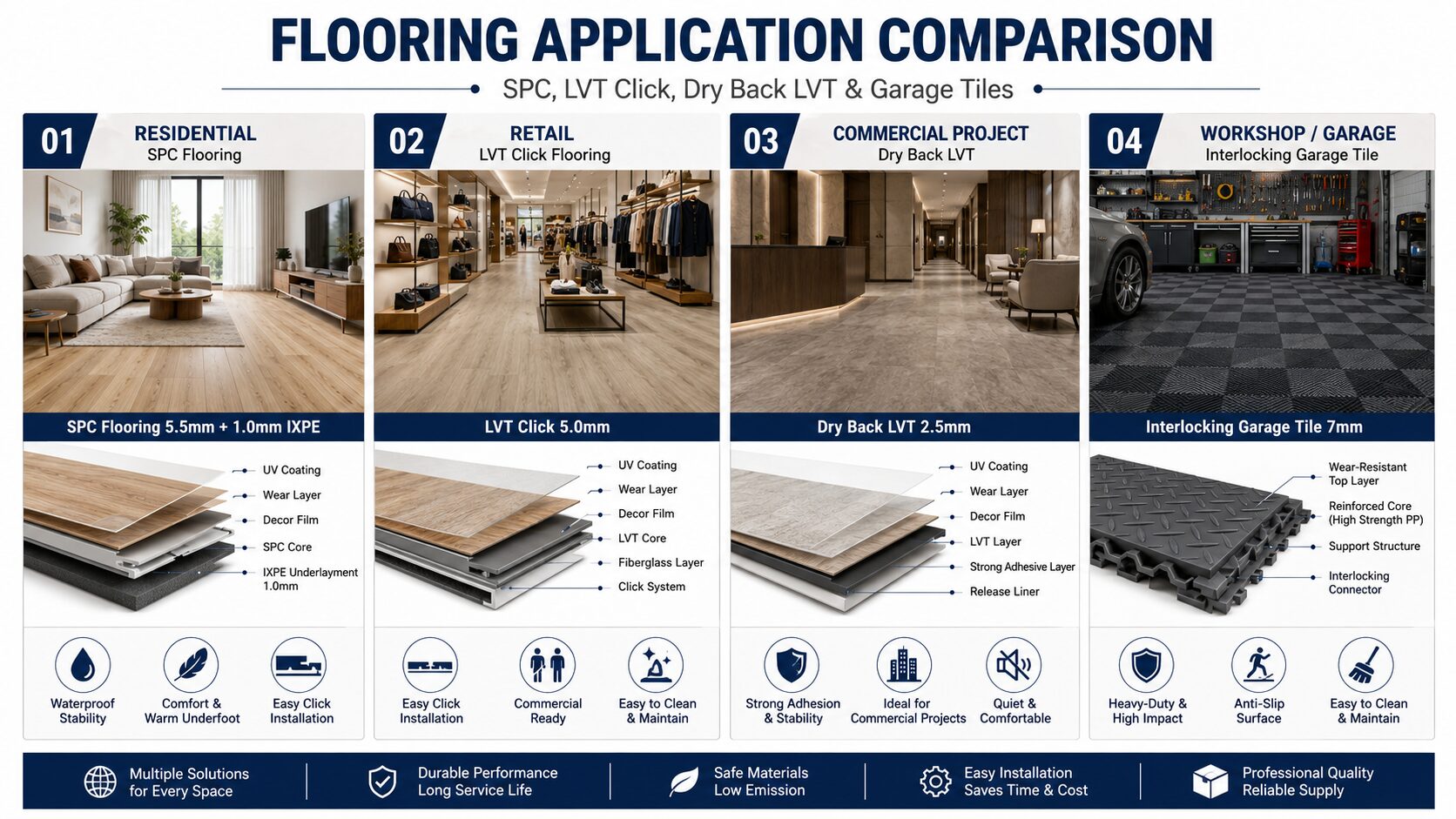
For some channels, Waterproof LVT Click Vinyl Flooring fits better than rigid SPC because it gives design flexibility and faster installation. For other projects, especially large commercial areas with controlled subfloors, dry back LVT still makes more sense. For garages, workshops and modular utility areas, Interlocking Garage Floor Tiles may solve impact and replacement problems better than forcing SPC into the wrong environment.
That is the correct WPC vs SPC comparison approach: match the structure to the jobsite, not to the trend.
China Factory Translation: What This Week Really Means
This week’s news does not say “SPC is weak.”
It says weak SPC is being exposed.
The rigid core category is still strong because it solves real market needs: waterproof performance, fast installation, stable visual design and broad price coverage. But buyers are now separating good SPC from cheap SPC.
Inside Zhangjiagang, the pressure is visible in daily quotation work. Buyers ask more technical questions. More customers request photos during production. More importers want density testing. More distributors ask about claim handling before placing repeat orders.
That is a healthy change.
A market that only buys cheaper will eventually receive worse goods.
A market that asks better questions forces factories to improve.
For AutoPP Floor, the practical direction is clear:
- Keep 4.2mm/0.3mm as a realistic residential baseline
- Push 5.5mm + 1.5mm IXPE for stronger programs
- Keep 20 mil wear layer for commercial channels
- Control UV coating consistency
- Avoid unstable recycled-core formulas
- Connect test reports to real production batches
- Help buyers choose SPC, LVT click, dry back LVT or garage tiles by application
Buyers who want to understand factory background can review the AutoPP Floor about us page before sending a project brief.
Importer Risk Map for Q3 2026
| Risk Area | What Goes Wrong | What Buyers Should Write Into Orders |
|---|---|---|
| SPC density | Click edge becomes brittle | Density target, testing method, sample retention |
| Wear layer | Product scratches early | Actual wear-layer tolerance, not only nominal claim |
| IXPE backing | Foam collapses under furniture | IXPE thickness and density requirement |
| UV coating | Gloss drops, whitening appears | UV coating standard and abrasion test |
| Click profile | Installation gaps and breakage | Click-cycle test and locking tolerance |
| Compliance | Documents fail customer audit | REACH, FloorScore, phthalate or VOC files by product |
| Heat stability | Buckling near windows | 80°C heat-cycle or dimensional stability test |
| Batch consistency | Repeat orders look different | Color batch control and carton mixing rule |
Buyer FAQ
Why are rigid core flooring failures getting more industry attention?
Because SPC and hybrid rigid core products gained market share quickly. As installed volume grows, weak products and poor jobsite decisions create more visible claims. The main risk areas are click strength, density, subfloor condition, RH control and correct product selection.
Is 3.5mm SPC still worth buying?
Only for very price-sensitive, light-use channels where the buyer clearly understands the risk. For serious retail distribution, 4.2mm/0.3mm is a safer starting point. For better programs, 5.5mm + 1.5mm IXPE gives more stability, better comfort and stronger selling value.
Does sustainability mean all recycled material is bad?
No. Controlled recycled content can be acceptable when the factory can document source, usage position and performance impact. Uncontrolled recycled filler in the SPC core is the danger. That is where brittleness and dimensional instability begin.
What should I send to a factory before asking for price?
Send target country, product use, thickness, wear layer, backing, installation type, annual volume, certification needs and expected price lane. Then the factory can recommend a real structure instead of throwing out a random FOB number.
Closing Note from Zhangjiagang
The June 2026 flooring market is not quiet. It is becoming stricter.
Rigid core claims are forcing better education. Sustainability reports are forcing better documentation. Global brand moves are showing that resilient flooring is becoming a more disciplined product category.
For importers, this is the right time to clean up supplier lists.
Keep factories that know their numbers.
Remove suppliers that only say “same quality, cheaper price.”
AutoPP Floor will keep building export programs around stable SPC, practical LVT, clear compliance files and honest factory communication. Buyers preparing Q3 or Q4 orders can send specifications through the AutoPP Floor contact page.
Published by AutoPP Floor | Zhangjiagang, Jiangsu, China